The Quiet Death of the Personal Website
There was a time when having a place on the internet meant actually having a place.
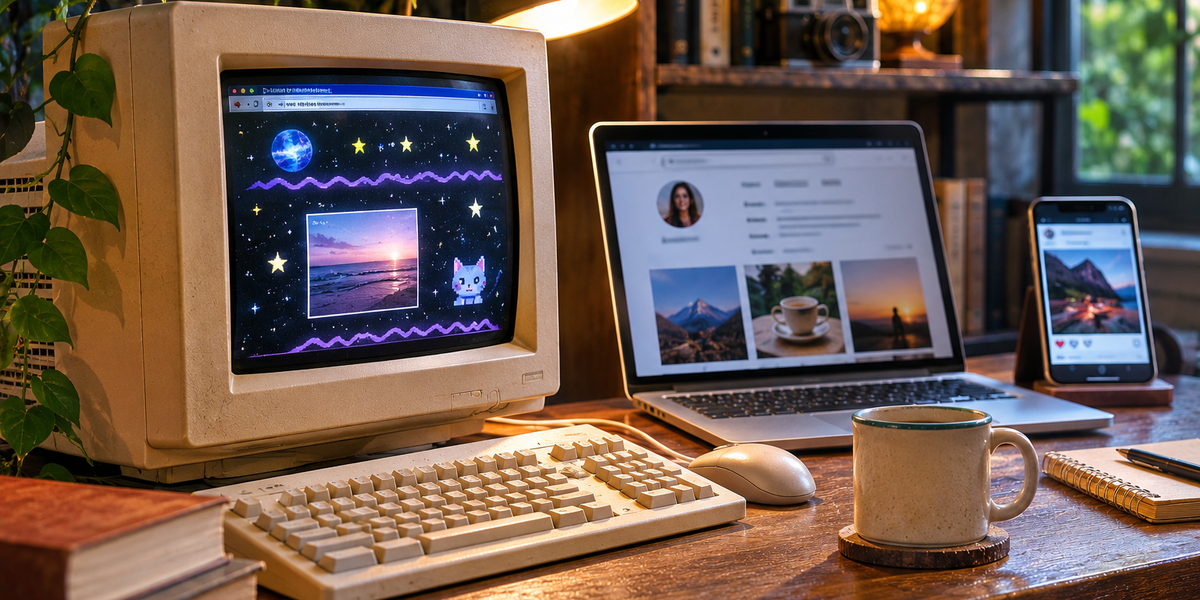
You might have built it badly. The background could have been purple. The text might have been yellow. There were probably too many GIFs, several broken links, a visitor counter at the bottom, and perhaps music that started playing without anyone’s permission. But it was yours.
A personal website could contain almost anything. Photographs, diary entries, essays, poetry, drawings, favorite songs, lists of links, travel stories, fan pages, strange collections, unfinished projects, or several paragraphs about an obscure hobby that only twelve other people on Earth appeared to care about.
There was no requirement for consistency. There was no algorithm to satisfy. Nobody asked about your engagement rate. You didn’t need to post three times a week to remain visible. Your website could sit untouched for six months and still be exactly where you left it.
Then, slowly, we stopped building our own spaces.
We moved into platforms.
The personal website didn’t disappear completely. Plenty still exist, and there has been renewed interest in independent websites, newsletters, blogs, and smaller online communities. But the personal website stopped being the default expression of an online identity.
Instead of building homes on the internet, most of us started renting rooms inside someone else’s building.
The Early Web Was Built From Individual Places
The early web was decentralized almost by accident. There wasn’t one destination where everyone created an account and uploaded everything about themselves. People moved between websites.
One site might contain movie reviews. Another contained someone’s photography. Another was dedicated entirely to a particular video game. Someone maintained a travel diary. Someone else documented every train station in their country. A teenager created a page about their favorite band.
The internet felt enormous because each website felt separate.
You traveled between them through links.
A link wasn’t merely a navigation tool. It was a recommendation. Someone had found another corner of the internet interesting enough to connect it to their own.
Entire communities formed through these networks of independent pages.
The web actually felt like a web.
Personal Websites Were Often Terrible
It is important not to romanticize the design.
Many personal websites were spectacularly ugly.
There were flashing banners, animated text, patterned backgrounds, tiny fonts, giant fonts, inexplicable color combinations, unnecessary frames, MIDI music, low-resolution photographs, and menus that seemed determined to prevent you from finding anything.
Modern web designers would probably need a moment.
But those imperfections created personality.
You could often tell something about the person before reading a single sentence.
The design itself was expressive.
Someone had chosen that terrible background.
Someone had deliberately placed that dancing GIF there.
Someone had decided their favorite quote absolutely needed to scroll horizontally across the screen.
The website looked like its owner.
That is surprisingly rare now.
The Modern Internet Looks Much More Consistent
Open ten Instagram profiles and they all follow the same structure.
Open ten TikTok profiles and the interface is nearly identical.
LinkedIn decides where your photograph goes.
YouTube decides where your videos appear.
X decides how your posts are displayed.
Facebook decides what information fits where.
The user provides the content.
The platform provides the architecture.
This standardization has enormous advantages. You don’t need to understand HTML to participate. You don’t need to design navigation. You don’t need hosting. You don’t need to worry about whether your page works on different screens.
Anyone can create an account in minutes.
But convenience came with a trade-off.
We stopped designing the spaces themselves.
Social Media Made Personal Websites Feel Unnecessary
The appeal of social platforms was obvious.
Why build a website and hope people discover it when everyone you know is already on Facebook?
Why maintain a photo gallery when Instagram makes uploading photographs effortless?
Why build a video site when YouTube already provides hosting, discovery, comments, subscriptions, and an enormous audience?
Why write short updates on a personal blog when you can post them directly to a platform where your friends will immediately see them?
Social media solved one of the hardest problems personal websites had always faced.
Distribution.
Building a website was relatively easy.
Getting anyone to visit it was much harder.
Platforms arrived with the audience already inside.
That was almost impossible to resist.
We Traded Control for Convenience
The bargain seemed excellent.
The platform would handle hosting.
Storage.
Design.
Security.
Discovery.
Comments.
Sharing.
Notifications.
Mobile applications.
We simply had to provide the content.
In return, however, the platform controlled the environment.
It could change the layout.
Change the algorithm.
Change what types of posts received visibility.
Introduce advertisements.
Remove features.
Add subscriptions.
Limit links.
Change moderation policies.
Suspend accounts.
Shut down entirely.
Your profile might feel like your space.
Technically, it never really was.
A Personal Website Doesn’t Have an Algorithm
One of the strangest things about a personal website is that nothing decides whether your visitors deserve to see what you published.
If you write an essay and place it at the top of your homepage, it stays there.
It doesn’t receive poor initial engagement and disappear.
It doesn’t need a certain number of comments to remain visible.
It doesn’t compete with a dancing video, breaking news, an advertisement, your friend’s holiday photographs, and seventeen posts selected because an algorithm thinks they will keep someone scrolling.
The visitor arrives because they chose to visit.
That creates a very different relationship between writer and reader.
The website doesn’t need to interrupt someone.
The reader comes to it.
Algorithms Changed What We Create
Once platforms began controlling distribution, creators naturally began learning what the platforms rewarded.
If short videos receive more reach, people make short videos.
If certain thumbnails perform better, people use those thumbnails.
If particular opening lines increase watch time, people begin using those opening lines.
If posting frequently increases visibility, people post frequently.
None of this requires a conspiracy.
People adapt to the environments they inhabit.
But gradually, the architecture of platforms begins shaping culture.
Creators aren’t simply asking, “What do I want to make?”
They’re also asking, “Will the algorithm show this to anyone?”
A personal website rarely asks that question.
The Feed Replaced the Homepage
The homepage was once one of the central organizing ideas of the web.
You arrived somewhere.
You looked around.
You chose what to explore.
Perhaps there was an About page.
An archive.
A blog.
A collection of links.
A photo gallery.
The website had geography.
Feeds changed that.
Instead of navigating between places, content comes to you in one continuous stream.
One person’s video appears next to another person’s photograph, followed by an advertisement, followed by news, followed by a stranger’s opinion, followed by a meme.
You don’t visit the creators.
Their content visits you.
This is enormously efficient.
It also makes the internet feel less like a collection of places and more like one endlessly moving surface.
The Timeline Changed How We Understand the Internet
Personal websites are organized spatially.
This page.
That section.
The archive.
The links.
The gallery.
Social media is organized primarily by time and recommendation.
What’s new?
What’s happening?
What’s trending?
What should you see next?
That creates pressure toward constant production.
A website can contain an essay written five years ago and treat it as equally important today.
A social feed naturally privileges the new.
Yesterday’s post is already disappearing.
Last month’s might as well be archaeological material.
This changes the rhythm of creation.
Instead of building a body of work, we often build a stream.
The Internet Started Forgetting More Quickly
The modern web contains an astonishing amount of information, yet individual pieces of content can feel strangely temporary.
A post goes viral.
Millions see it.
Three weeks later, nobody remembers it.
Feeds are designed to move.
The next thing always arrives.
Personal websites operated differently.
Archives were part of their structure.
An article published in 2008 could sit next to one published yesterday.
A visitor could deliberately browse backward.
The website accumulated.
It became a record of someone’s thinking over time.
Feeds accumulate too, technically.
But psychologically, they emphasize the present.
Blogging Once Meant Something Different
Before content marketing became an industry, blogging was often remarkably personal.
People wrote because they had something to say.
Sometimes the posts were thoughtful essays.
Sometimes they were three paragraphs about a bad day.
Sometimes they were reviews.
Travel diaries.
Political arguments.
Technical tutorials.
Recipes.
Personal reflections.
Photographs.
The boundaries were loose.
Then businesses discovered blogging.
Search engines became major traffic sources.
SEO developed.
Affiliate marketing expanded.
Content marketing grew.
Blogs became professional publishing operations.
Again, none of this was necessarily bad. Professional online publishing produced enormous amounts of useful information.
But the word “blog” slowly stopped automatically suggesting someone’s personal corner of the internet.
It started suggesting content.
Those aren’t quite the same thing.
SEO Changed the Way the Web Speaks
Search engines created another powerful incentive.
If you wanted people to discover your writing, you needed to understand what they searched for.
That encouraged useful practices. Clear headlines, logical structure, descriptive language, and accessible information genuinely help readers.
But optimization can also make writing converge.
Certain headline structures become common.
Certain article formats appear repeatedly.
Certain topics get written about because people search for them.
Other topics receive little attention because they have no obvious traffic potential.
A person writing on their own website doesn’t necessarily need to care.
They can write an essay called “Something I Thought About While Waiting for the Train.”
Search volume: approximately nobody.
Human value: potentially enormous.
Social Media Turned People Into Brands
Personal websites existed before “personal brand” became everyday language.
Today, professionals are often encouraged to think strategically about their online presence.
Choose your niche.
Define your audience.
Create content pillars.
Maintain visual consistency.
Post regularly.
Build authority.
Track engagement.
Optimize your profile.
There can be real professional value in doing this.
But it also changes how people think about self-expression.
A human being is inconsistent.
A brand prefers consistency.
A person can be interested in technology on Monday, motherhood on Tuesday, architecture on Wednesday, and a completely random memory from childhood on Thursday.
A personal website can contain all four.
A personal brand may ask which one fits the content strategy.
The Personal Website Allowed Contradiction
One of the beautiful things about an independent site is that it doesn’t need a niche unless its owner wants one.
You can publish a serious essay next to a recipe.
A travel photograph next to a professional project.
A poem next to a technical tutorial.
A page dedicated entirely to books you’ve loved.
The website can reflect the messiness of a person rather than the clarity of a product category.
Modern creator culture often rewards specialization because audiences and algorithms need to understand quickly what someone offers.
Personal websites can resist that pressure.
They can say:
“This is simply what I’m interested in.”
We Lost Some Anonymity Too
Early personal websites often existed under usernames and pseudonyms.
Someone could become respected inside an online community without connecting everything they created to their legal identity.
Modern platforms increasingly encourage unified identities.
Your photograph.
Your real name.
Your profession.
Your employer.
Your location.
Your network.
That can increase accountability.
It can also make experimentation more intimidating.
Writing something uncertain feels different when it is attached permanently to the same profile your future employer might inspect.
A pseudonymous personal website allowed people to try ideas without necessarily turning every thought into part of their professional identity.
Platforms Made Us Easier to Find
There is an obvious reason we accepted all these trade-offs.
Platforms work.
If you publish a personal essay on an independent website, perhaps fifty people will see it.
Publish the right video on a major platform and fifty thousand might.
The distribution power is incomparable.
Social platforms solved the loneliness of publishing into empty space.
They connected creators to audiences.
They helped artists, writers, businesses, activists, educators, and ordinary people reach communities that would have been almost impossible to find otherwise.
The decline of personal websites wasn’t caused by collective stupidity.
We moved because platforms offered something incredibly valuable.
People.
But Platforms Can Change the Rules Overnight
The problem with building entirely inside someone else’s platform becomes obvious when the platform changes.
Perhaps organic reach declines.
Perhaps the algorithm begins prioritizing video.
Perhaps links are discouraged.
Perhaps monetization rules change.
Perhaps the platform loses popularity.
Perhaps your account is suspended.
Perhaps a feature disappears.
Perhaps the company itself eventually disappears.
Years of work can suddenly depend on decisions made by a company you’ve never interacted with.
A personal website doesn’t solve every problem.
But it gives you one thing platforms can’t fully offer.
A digital base you control.
Your Followers Aren’t Necessarily Yours
Someone can have hundreds of thousands of followers and still depend entirely on a platform to reach them.
The number appears enormous.
But the platform decides how many of those people actually see each post.
This is why many creators eventually encourage audiences to join email lists, newsletters, memberships, or independent communities.
They’re trying to create a direct connection.
The lesson is old.
If your relationship with your audience exists entirely through an intermediary, the intermediary has power.
Personal websites and email newsletters reduce that dependency.
Not completely.
But significantly.
The Death Was Quiet Because Nobody Deleted the Web
There was no moment when personal websites officially ended.
No announcement.
No funeral.
No final homepage.
They simply became less common.
Someone stopped updating their blog.
Another person moved their photographs to Instagram.
Someone let a domain expire.
A fan site disappeared.
A forum closed.
A collection of links became outdated.
A personal homepage remained online for ten years after its owner forgot the password.
The web didn’t vanish.
It slowly emptied into platforms.
That’s why the change was easy to miss.
Link Rot Is Erasing Parts of Internet History
The web is surprisingly fragile.
Websites disappear.
Domains expire.
Hosting companies close.
Pages are redesigned.
Images break.
URLs change.
Old services shut down.
When that happens, links pointing to those resources stop working.
This phenomenon, often called link rot, means parts of the web gradually become inaccessible even though references to them remain.
A printed book from 1995 can sit on a shelf unchanged.
A website from 1995 may have disappeared fifteen hosting providers ago.
Digital doesn’t automatically mean permanent.
Sometimes the opposite is true.
Social Platforms Can Disappear Too
The history of the internet is full of platforms that once seemed permanent.
People built communities, uploaded photographs, wrote posts, and invested enormous amounts of time into services that later declined, transformed, or disappeared.
This should make us cautious about treating today’s dominant platforms as permanent infrastructure.
The internet changes quickly.
Twenty years is an eternity in technology.
A personal website isn’t immortal either.
Domains need renewal.
Hosting needs maintenance.
Software needs updates.
But the owner has more options.
Content can be backed up.
Moved.
Redesigned.
Exported.
The identity doesn’t have to disappear because one social network loses relevance.
We Replaced URLs With Usernames
There was once something powerful about giving someone your website address.
It was a location you controlled.
Now we often give usernames.
Find me on Instagram.
Follow me on TikTok.
Add me on LinkedIn.
Subscribe on YouTube.
Our digital identities became coordinates inside corporate platforms.
That shift seems small, but it represents a major change in how the internet is structured.
A URL points to a place on the web.
A username points to a person inside a platform.
The first belongs to an open network.
The second depends on a company.
The Personal Website Was a Digital Home
This may be the best metaphor.
Social media is rented space.
A personal website is closer to owning a small house.
The rented apartment may have better amenities.
More people live nearby.
Maintenance is easier.
Security is handled.
Everything works immediately.
But the landlord makes the rules.
Your own house requires more work.
You have to maintain it.
Fix things.
Pay for it.
Decide how it looks.
Sometimes nobody visits.
But you can paint the walls whatever ridiculous color you want.
That freedom was always part of the web’s original appeal.
Newsletters Are Quietly Recreating Part of the Old Internet
Interestingly, the desire for direct relationships hasn’t disappeared.
Email newsletters have experienced renewed popularity partly because they restore something platforms weakened.
Direct connection.
A writer publishes.
The reader receives it.
There is less dependence on an algorithm deciding whether the content deserves visibility.
Newsletters aren’t personal websites, but the philosophy overlaps.
People increasingly want smaller spaces.
Direct audiences.
Communities they can recognize.
Content they deliberately choose rather than content endlessly recommended to them.
The internet may be slowly rediscovering some of what it abandoned.
Small Online Communities Are Returning Too
Large social platforms aren’t disappearing, but many people are increasingly dividing their online lives between public feeds and smaller spaces.
Private Discord servers.
Group chats.
Paid communities.
Specialized forums.
Newsletters.
Niche social networks.
Personal blogs.
These spaces don’t necessarily need millions of users.
In fact, their value can come from being smaller.
A community of 300 people who recognize each other can feel more meaningful than a feed containing 300 million strangers.
Scale is useful for distribution.
It isn’t always useful for belonging.
AI Gives Personal Websites a New Reason to Exist
Generative AI may unexpectedly make independent websites more interesting again.
As the internet fills with enormous amounts of automatically generated content, knowing where something came from becomes increasingly valuable.
A personal website can provide continuity.
This is what I wrote.
These are my photographs.
These are my projects.
These are my ideas over time.
The website becomes not merely a publishing platform but a record of authorship.
In a digital environment where content can increasingly be generated at scale, a clearly identifiable human archive may become more meaningful rather than less.
Personal Websites Don’t Need to Compete With Social Media
Perhaps the mistake is assuming we must choose.
A personal website doesn’t need to replace Instagram, TikTok, LinkedIn, YouTube, or any other platform.
Those platforms remain extraordinary distribution systems.
They can introduce your work to people who would never independently discover your domain.
But the relationship can work differently.
Social media can be the road.
Your website can be the destination.
You can discover people through platforms while maintaining a permanent home elsewhere.
The platform distributes.
The website accumulates.
A Website Can Grow With You
One underrated advantage of owning a personal site is that it doesn’t need to remain what it started as.
A student might begin with a simple blog.
Years later, it becomes a professional portfolio.
Then perhaps it contains essays.
Projects.
Photography.
Research.
Travel.
A newsletter.
A business.
An archive.
The site changes as the person changes.
That continuity is difficult to reproduce across social platforms that rise and fall over decades.
A personal domain can become a thread connecting multiple versions of your life.
The New Luxury Might Be a Small Audience
For years, the internet taught us that bigger numbers were automatically better.
More followers.
More views.
More subscribers.
More reach.
More engagement.
But a different idea is becoming attractive.
What if 500 people genuinely reading your work is enough?
What if the goal isn’t virality?
What if something can be valuable without scaling?
What if a website exists simply because you wanted somewhere to put your thoughts?
The early internet understood this almost accidentally.
A website didn’t need to become a media company.
It could simply exist.
We May Have Optimized Away Some of the Internet’s Humanity
The modern internet is extraordinarily efficient.
Platforms make publishing effortless.
Algorithms make discovery effortless.
Templates make design effortless.
Analytics make performance measurable.
AI increasingly makes production easier too.
But human culture isn’t always improved by efficiency.
Sometimes the interesting part is the unnecessary part.
The weird page someone spent three weekends building.
The essay nobody searched for.
The collection that makes no commercial sense.
The blog updated twice a year.
The design choice that violates every usability principle but somehow tells you exactly who made it.
Those things are difficult to optimize because optimization was never their purpose.
The Personal Website Isn’t Actually Dead
Perhaps “death” is too dramatic.
The personal website became quieter.
It moved away from the center of internet culture while giant platforms took over distribution.
But the infrastructure never disappeared.
Anyone can still register a domain.
Build a page.
Write.
Publish photographs.
Create an archive.
Link to other people.
Make something strange.
In fact, modern tools make building a good website dramatically easier than it was during the era we now remember nostalgically.
The barrier isn’t really technical anymore.
It’s cultural.
We’ve become accustomed to the idea that publishing means posting on a platform.
It doesn’t have to.
The Simple Version
The personal website quietly declined because platforms solved its biggest weaknesses. Social media made publishing easier, provided instant audiences, handled technical infrastructure, and made discovery dramatically more powerful.
In exchange, we gave platforms control over the design, distribution, visibility, and sometimes longevity of our online identities.
We gained convenience.
We lost some ownership.
We gained enormous audiences.
We lost some individuality.
We gained feeds that always know what to show us next.
We lost some of the feeling of wandering between places built by actual people.
The personal website may never become the center of the internet again.
Maybe it doesn’t need to.
Its value today might come precisely from being outside the center.
A small place with no algorithm, no requirement to go viral, no content strategy unless you want one, and no need to explain why it exists.
Just a corner of the internet that belongs to you.
And in an online world increasingly built on rented space, that suddenly feels surprisingly radical.