Why “Authenticity” Became the Most Marketed Word Online
Open almost any social platform and eventually someone will promise you authenticity.
A creator is “showing the real side.”
A brand is telling “real stories.”
A founder is being “vulnerable.”
A celebrity posts a makeup-free photograph.
An influencer uploads a deliberately imperfect morning routine.
A company announces that it wants to have “real conversations” with its community.
Even advertisements now try very hard not to look like advertisements.
Everything is candid.
Everything is relatable.
Everything is supposedly real.
And that creates a strange contradiction.
Authenticity has become one of the most carefully manufactured things on the internet.
This doesn’t mean everyone online is pretending. Plenty of people share genuinely personal, spontaneous, and imperfect parts of their lives.
The more interesting question is why being perceived as authentic became so valuable in the first place.
The answer has a lot to do with what happened as the internet became more polished, more commercial, more algorithmic, and more crowded. When almost everything started looking like marketing, looking like you weren’t marketing anything became incredibly powerful.
The Early Internet Was Messier
The internet didn’t always look this polished.
Personal websites were strange.
Blogs were inconsistent.
Photographs were badly lit.
People wrote long posts without worrying about search optimization.
Social media profiles contained blurry party photographs, random status updates, terrible filters, song lyrics, inside jokes, and things most people would now hesitate to attach permanently to their names.
There was less pressure to behave like a publisher.
Most people weren’t thinking about engagement rates, personal brands, audience growth, content strategy, or monetization.
They were simply posting.
That messiness created a certain kind of authenticity almost accidentally.
Then social media became an industry.
Everyone Became a Publisher
Once platforms developed enormous audiences, posting online became something more than casual communication.
Creators built careers.
Businesses built marketing departments around social media.
Celebrities communicated directly with fans.
Politicians, journalists, entrepreneurs, coaches, consultants, and ordinary professionals started developing public identities online.
Suddenly, your profile wasn’t simply your profile.
It could be your portfolio.
Your business card.
Your storefront.
Your résumé.
Your media channel.
Your personal brand.
The stakes changed.
And when the stakes changed, people became more careful about what they posted.
The Internet Became Extremely Polished
For a while, polish became the goal.
Perfect photographs.
Perfect homes.
Perfect outfits.
Perfect breakfasts.
Perfect holidays.
Perfect productivity routines.
Everything was color coordinated.
People learned how to pose.
They learned which angles worked.
They learned how to edit photographs.
Creators developed recognizable visual styles.
Brands adopted immaculate social media aesthetics.
Even ordinary people started thinking about whether a photograph was “Instagrammable.”
Eventually, perfection created its own problem.
Everyone became tired of it.
Perfection Stops Feeling Trustworthy
When everything looks perfect, people start wondering what’s being hidden.
You know the photograph was selected from twenty versions.
You know the kitchen doesn’t always look like that.
You know the holiday had delayed flights and arguments and bad weather somewhere outside the frame.
You know the person probably doesn’t wake up looking exactly like the “morning routine” video.
The audience became media literate.
We learned the tricks.
Filters.
Lighting.
Editing.
Sponsorships.
Affiliate links.
Product placement.
PR packages.
Carefully planned “spontaneous” photographs.
Once people understand how easily reality can be curated, perfection becomes less persuasive.
Imperfection starts feeling more credible.
And marketers notice what feels credible.
Imperfection Became a Strategy
This is where things get interesting.
If highly polished content looks artificial, the obvious alternative is content that looks unpolished.
So advertisements begin looking like ordinary phone videos.
Creators leave in mistakes.
Brands use casual language.
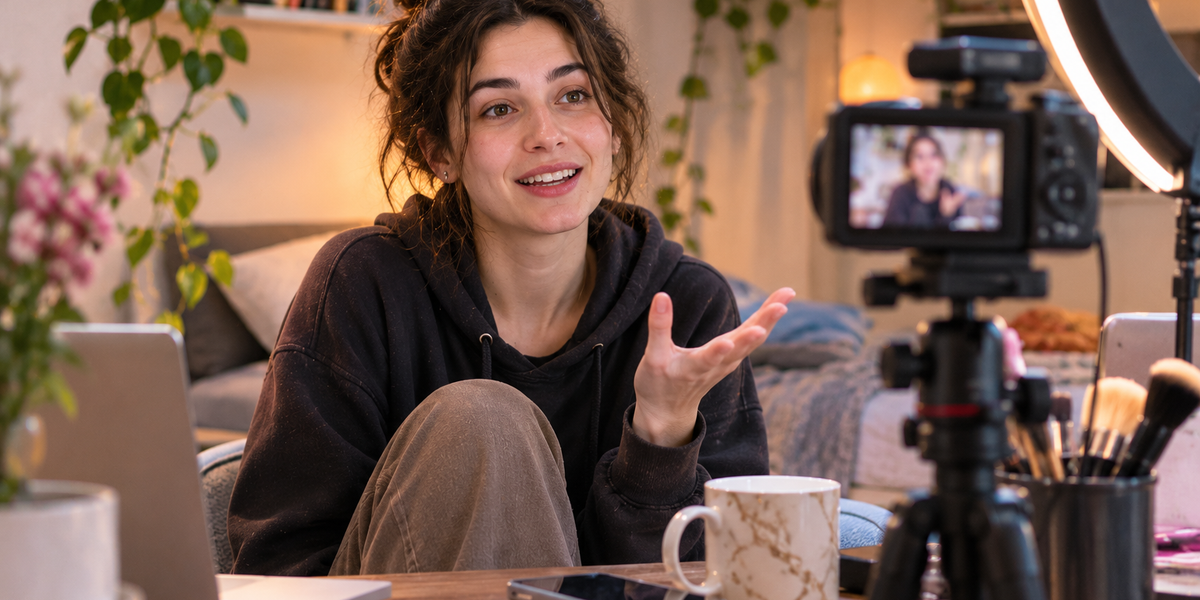
Videos start with someone apparently speaking spontaneously into a front-facing camera.
Lighting becomes intentionally ordinary.
Editing becomes deliberately less perfect.
The content says:
“This isn’t an ad.”
Sometimes immediately before becoming an ad.
The aesthetic of authenticity becomes a marketing technique.
“Relatable” Became a Business Model
Relatability is incredibly valuable online because it reduces distance.
Traditional celebrities often seemed unreachable.
Influencers changed that relationship.
An influencer might show their bedroom.
Talk about their breakup.
Complain about laundry.
Show what they eat.
Discuss anxiety before a meeting.
Take followers shopping.
Answer comments.
Film themselves without professional cameras.
The audience begins to feel:
“She’s like me.”
That feeling is commercially powerful.
If someone feels like a friend rather than an advertiser, their recommendations may carry more emotional weight.
A television commercial tells you a product is good.
A relatable creator says:
“I’ve been using this for three weeks and genuinely didn’t expect to love it.”
The second version sounds more like advice.
That’s the point.
We Trust People More Than Institutions
People often respond differently to recommendations from individuals than to messages from corporations.
A company telling you its product is excellent is expected.
Of course it thinks that.
A person telling you they use the product feels different.
It appears to contain personal judgment.
Social media marketing increasingly relies on that difference.
Instead of the brand being the main character, the customer or creator becomes the messenger.
The advertisement becomes a recommendation.
The campaign becomes a story.
The product becomes something that “just happens” to appear inside someone’s normal life.
Authenticity becomes the bridge between commerce and trust.
The Influencer’s Greatest Product Is Trust
An influencer can have beautiful photography, excellent editing, and millions of followers.
But without audience trust, their commercial value weakens.
Their real asset isn’t simply reach.
It’s credibility.
Followers need to believe some version of:
“This person wouldn’t recommend something terrible just for money.”
That’s why authenticity matters so much in creator culture.
A creator who promotes everything risks losing trust.
A creator who occasionally criticizes products can appear more credible.
Someone who openly says, “This part I liked, this part I didn’t,” may become more persuasive than someone who says every sponsored product changed their life.
Ironically, saying negative things can sometimes make positive recommendations more commercially valuable.
Because skepticism itself becomes evidence of authenticity.
Vulnerability Became Content
The shift toward authenticity also changed what people share.
Instead of only showing success, creators began showing difficulty.
Burnout.
Breakups.
Body-image struggles.
Career failures.
Parenting exhaustion.
Financial problems.
Loneliness.
Mental-health experiences.
Bad days.
These conversations can be genuinely valuable.
Seeing someone discuss an experience you’ve had can make you feel less alone.
But once vulnerability performs well online, another uncomfortable possibility appears.
Vulnerability can become part of the content strategy.
A deeply personal story can generate enormous engagement.
Engagement can generate audience growth.
Audience growth can generate money.
That doesn’t automatically make the vulnerability fake.
The uncomfortable truth is that something can be genuinely vulnerable and commercially useful at the same time.
The internet doesn’t force us to choose one explanation.
Authenticity Doesn’t Mean Showing Everything
One of the biggest misunderstandings about authenticity is the idea that being authentic means revealing your entire life.
It doesn’t.
A person can be completely honest about what they choose to share while keeping most of their life private.
You can talk honestly about motherhood without showing your child’s private moments.
You can discuss your career without revealing every workplace conflict.
You can share a relationship without turning your partner into content.
You can talk about a difficult period after you’ve processed it rather than livestreaming your pain while it’s happening.
Privacy isn’t dishonesty.
Boundaries aren’t evidence that someone is fake.
Authenticity should mean that what you show is truthful—not that you owe the internet everything.
The Camera Changes Behavior
There’s another problem with the idea of perfectly authentic content.
The moment a camera appears, behavior changes.
Imagine someone filming themselves crying.
The emotion may be completely real.
But at some point, they also had to position the phone.
Perhaps check the framing.
Press record.
Maybe edit the footage.
Choose whether to publish it.
Write a caption.
That doesn’t prove the emotion was fake.
It simply shows how difficult it is to separate experience from performance once something becomes content.
The camera doesn’t automatically create dishonesty.
But it introduces an audience.
And humans behave differently when we know we’re being watched.
Even “Being Yourself” Can Become a Performance
Suppose a creator becomes popular because they’re chaotic, funny, and unfiltered.
The audience loves that personality.
Now there’s pressure to continue being chaotic, funny, and unfiltered.
The creator may genuinely have those traits.
But those traits have also become part of the product.
Now “being yourself” comes with expectations.
Followers expect certain jokes.
Certain opinions.
Certain stories.
Certain levels of openness.
The authentic personality becomes a brand identity.
That’s one of the strangest contradictions of internet fame.
You can become trapped performing the version of yourself that originally became popular because it didn’t feel like a performance.
Personal Branding Made the Problem Bigger
The phrase “personal brand” contains a contradiction of its own.
A person is complicated.
A brand needs consistency.
Real people change their minds.
Brands prefer recognizable positioning.
People have contradictory interests.
Brands prefer clear categories.
People behave differently in different environments.
Brands prefer a stable voice.
Once individuals start thinking about themselves as brands, there’s pressure to simplify.
You’re the productivity person.
The minimalist.
The career woman.
The funny mother.
The finance guy.
The wellness creator.
The brutally honest founder.
The person who “always keeps it real.”
Eventually even authenticity needs brand guidelines.
“No Filter” Became Its Own Filter
Online aesthetics have repeatedly responded to whatever came before them.
When heavily edited photographs became exhausting, people wanted natural photographs.
When perfect feeds became boring, photo dumps became fashionable.
When professional videos felt too corporate, shaky phone footage became appealing.
When polished advertising became easy to recognize, user-generated content became commercially attractive.
But once enough people adopt the “unpolished” aesthetic, it develops conventions too.
The casual photograph can be carefully selected.
The messy bedroom can be aesthetically messy.
The photo dump can take forty minutes to curate.
The spontaneous video can have a script.
The “I wasn’t going to post this” post can absolutely have been planned for Tuesday at 7 p.m.
Authenticity develops an aesthetic.
And once something has an aesthetic, it can be reproduced.
Brands Learned to Sound Like People
Corporate communication used to sound unmistakably corporate.
Formal sentences.
Careful language.
Official announcements.
Then brands discovered social media personality.
Suddenly companies were making jokes.
Using slang.
Replying to customers like friends.
Posting memes.
Commenting on pop culture.
Pretending the social media manager had stolen the company account.
Sometimes this is genuinely funny.
But it’s also a strategy.
Brands want to reduce the psychological distance between corporation and consumer.
The company doesn’t want to feel like an institution.
It wants to feel like someone you might follow voluntarily.
Human language creates human warmth.
Human warmth can create engagement.
Engagement can create sales.
Even Ads Learned to Hide Their Polish
Traditional advertisements wanted you to know they were advertisements.
Beautiful lighting.
Professional actors.
Perfect sets.
Expensive cameras.
Dramatic music.
Modern social advertising often does the opposite.
Someone sits in their car.
“This is so random, but I need to tell you about this.”
Someone films in their bathroom.
“I’ve been gatekeeping this.”
Someone holds a product toward the camera.
“I genuinely didn’t think this would work.”
The aesthetic says ordinary person.
The infrastructure behind it may involve contracts, creative briefs, performance analytics, affiliate tracking, agencies, and advertising budgets.
This doesn’t mean the person is necessarily lying.
It means authenticity has become valuable enough that advertising learned how to imitate its visual language.
Algorithms Reward Emotional Immediacy
Authentic-feeling content also fits algorithmic platforms extremely well.
A polished advertisement can feel distant.
A person looking directly into a phone camera and saying, “Okay, I need to talk about this” creates immediate curiosity.
It feels like the beginning of a conversation.
Strong emotion can create attention.
Confession creates curiosity.
Personal stories keep people watching.
Comments become more emotional.
People share similar experiences.
The platform sees engagement.
The content travels further.
This creates an incentive for creators to make content increasingly personal.
Not because an algorithm understands authenticity.
Because it understands the behaviors authenticity can produce.
Audiences Became Better at Detecting Marketing
There’s a constant arms race between advertising and consumer awareness.
A marketing technique works.
People become familiar with it.
It stops working as well.
Marketing adapts.
Banner advertisements become easy to ignore.
Brands move into social feeds.
Obvious influencer advertisements become easy to recognize.
Sponsored content becomes more natural.
Audiences become suspicious of perfect recommendations.
Creators begin emphasizing what they dislike.
The audience becomes skeptical of exaggerated enthusiasm.
Marketing becomes more understated.
Every time consumers learn the language of persuasion, persuasion learns a new language.
Authenticity is currently one of its most effective dialects.
“I Bought This Myself” Became Powerful
Notice how persuasive certain phrases have become online.
“Not sponsored.”
“I bought this with my own money.”
“They don’t know I’m posting this.”
“I’ve actually used this for years.”
“I wouldn’t recommend the other one.”
These statements matter because they address the audience’s central suspicion:
Are you saying this because you believe it or because you’re being paid?
The more commercial the internet becomes, the more valuable independence appears.
That’s why creators sometimes go out of their way to explain when something isn’t sponsored.
The absence of payment itself becomes part of the recommendation.
We Want Proof That Real People Still Exist Online
There’s also something deeper happening.
The internet is increasingly populated by optimized content.
SEO articles.
Professional creators.
Corporate accounts.
Recommendation algorithms.
Automated posts.
AI-generated images.
AI-generated text.
AI-generated video.
Highly edited personal brands.
As synthetic and optimized content becomes easier to produce, evidence of actual human experience becomes more valuable.
People want fingerprints.
Specific details.
Odd opinions.
Mistakes.
Contradictions.
Stories that don’t sound focus-grouped.
A voice that doesn’t sound interchangeable with everyone else’s.
The demand for authenticity is partly a reaction to a digital environment that increasingly makes us ask:
“Was there actually a person behind this?”
AI Makes Authenticity More Valuable—and Harder to Prove
Generative AI intensifies the problem.
It can produce polished writing, realistic images, synthetic voices, marketing copy, videos, product descriptions, comments, and social content at extraordinary scale.
That means polish is no longer strong evidence of effort.
Even apparent imperfection can be generated intentionally.
An AI system can write casually.
It can add slang.
It can imitate hesitation.
It can produce something designed to sound vulnerable.
So the internet faces an interesting future.
The more easily authenticity can be simulated, the more valuable genuine human experience may become.
But distinguishing between the two may also become harder.
Specificity Is Harder to Fake Than “Authenticity”
One reason generic authenticity often feels artificial is that it relies on familiar signals.
“I’m being vulnerable.”
“Nobody talks about this.”
“Here’s the real truth.”
“I wanted to show you the unfiltered side.”
Those phrases tell you something is authentic.
But genuinely convincing personal communication often doesn’t need to announce itself.
It contains specific details.
An unusual observation.
A memory that couldn’t belong to everyone.
A complicated opinion.
A small contradiction.
A detail that doesn’t neatly support the story.
Real life is messy.
Marketing usually wants a clean message.
That’s why specificity often feels more human than declarations of authenticity.
Real People Contradict Themselves
Brands hate contradiction.
Humans are full of it.
You can love your career and want to quit on Tuesday.
You can adore motherhood and desperately want an afternoon alone.
You can care about sustainability and occasionally buy something unnecessary.
You can believe social media is unhealthy and still spend an hour scrolling.
You can love your partner and be furious with them.
You can be confident and insecure in the same week.
Authenticity allows contradiction.
Personal branding often tries to remove it.
That’s why highly optimized online personalities can eventually feel strangely flat.
Real humans aren’t perfectly positioned.
The Pressure to Be Authentic Can Become Exhausting
There’s an irony in being told to “just be yourself” in front of thousands of people.
Which self?
The professional one?
The tired one?
The funny one?
The angry one?
The person you are with your closest friend?
The person you are with your parents?
Humans naturally behave differently in different contexts.
That’s not necessarily deception.
It’s social intelligence.
Online culture sometimes treats consistency as proof of authenticity, when real people are often inconsistent.
The demand to constantly prove that you’re “real” can become another performance requirement.
Now you don’t merely have to create content.
You have to demonstrate that you aren’t trying too hard while creating it.
That’s quite a lot of trying.
Oversharing Is Not the Same as Authenticity
One of the more damaging consequences of authenticity culture is the idea that the most personal person is automatically the most genuine.
They’re not.
Sharing trauma doesn’t make someone more authentic.
Showing children during vulnerable moments doesn’t make parenting content more honest.
Publishing relationship arguments doesn’t make a relationship more real.
Filming yourself at your lowest point doesn’t automatically make content meaningful.
Sometimes authenticity looks like disclosure.
Sometimes it looks like saying:
“This part isn’t for the internet.”
The ability to maintain boundaries may become increasingly important as more of life becomes potentially publishable.
You Can Be Curated and Still Be Honest
Every form of communication involves selection.
When someone asks how your holiday was, you don’t provide a minute-by-minute transcript.
You choose what to tell them.
A photograph is already a selection.
A story is a selection.
A memoir is a selection.
A social media account will always be a selection.
So curation isn’t automatically dishonest.
The question is whether the selection creates a deliberately misleading impression.
Someone can post beautiful travel photographs while openly acknowledging that travel also includes exhaustion, expense, and missed trains.
The beautiful photographs aren’t fake.
They’re simply part of the experience.
Authenticity doesn’t require eliminating curation.
It requires understanding the difference between curation and deception.
The Most Authentic People Often Stop Announcing It
There’s something suspicious about constantly telling people how authentic you are.
It’s similar to repeatedly announcing that you’re extremely humble.
Eventually, the statement begins undermining itself.
Genuine authenticity usually emerges indirectly.
Through consistency between words and behavior.
Through specificity.
Through admitting uncertainty.
Through acknowledging mistakes without turning every mistake into a personal-brand redemption arc.
Through having opinions that aren’t perfectly optimized for applause.
Through maintaining boundaries.
Through occasionally saying nothing.
The strongest evidence that someone is real is rarely the word “real” in their bio.
Authenticity Became Valuable Because Trust Became Scarce
This may be the simplest explanation for the entire phenomenon.
We live in an environment overflowing with persuasion.
Advertisements.
Sponsored posts.
Affiliate links.
PR campaigns.
Personal brands.
Political messaging.
Corporate messaging.
AI-generated content.
Edited photographs.
Recommendation algorithms.
Influencer partnerships.
Everyone wants a piece of our attention.
When persuasion becomes abundant, trust becomes scarce.
And when trust becomes scarce, authenticity becomes valuable.
That’s why everyone wants to claim it.
Creators.
Brands.
Companies.
Celebrities.
Executives.
Advertisers.
Even technology products.
They’re all trying to communicate the same message:
“You can trust this because it’s real.”
The more frequently that message appears, of course, the more suspicious we become.
And the cycle starts again.
The Better Question Is Not “Is This Authentic?”
It’s almost impossible to know whether another person’s online identity represents their complete private reality.
And usually, it doesn’t need to.
A better set of questions is more practical.
Is this person clear about advertising?
Do they distinguish personal experience from fact?
Do they acknowledge limitations?
Do they change their recommendation every time a new sponsor appears?
Does their behavior generally match what they claim to value?
Are they comfortable saying they don’t know something?
Do they seem to have boundaries?
Are they selling you something while pretending they aren’t?
Those questions are more useful than trying to determine whether someone is somehow 100 percent “real.”
Nobody is presenting 100 percent of themselves online.
The Simple Version
Authenticity became one of the most marketed ideas online because the internet became incredibly good at manufacturing appearances.
As social media grew more polished, commercial, algorithmic, and professional, audiences became more skeptical of perfection.
So imperfection became valuable.
Relatability became valuable.
Vulnerability became valuable.
Casualness became valuable.
Being “real” became valuable.
And once authenticity became valuable, it became marketable.
That’s the paradox.
We wanted people and brands to stop performing.
So they learned how to perform not performing.
But genuine authenticity probably isn’t a particular camera angle, photo dump, makeup-free selfie, messy bedroom, vulnerable caption, or casual way of speaking.
It’s something less visually obvious.
It’s the gap between what someone presents and what they actually believe being relatively small.
And perhaps that’s why the most convincing authenticity online rarely needs to announce itself.
It simply feels like there’s still a person behind the screen.