How AI Actually Works (No Math Required)
Artificial intelligence can write an email, generate an image, recognize a face in a photo, recommend a movie, translate a sentence, help write computer code, and answer questions about almost anything. Because the results can feel surprisingly human, it’s easy to imagine that somewhere inside the machine there is a digital brain thinking through the problem.
That’s not really what’s happening.
Modern AI is built from mathematical models trained to recognize patterns in enormous amounts of data. Instead of programmers manually writing a rule for every possible situation, the system learns statistical relationships from examples and uses those relationships to produce predictions or outputs when it encounters something new.
The mathematics behind that process can become extremely complicated. Fortunately, you don’t need the math to understand the basic idea.
Traditional Software Follows Rules. AI Learns Patterns
Traditional computer programs are usually built around explicit instructions. A programmer writes rules telling the computer what to do under particular conditions. If this happens, do that. If the user clicks this button, open that page. If the password is incorrect, reject the login.
Artificial intelligence works differently. Instead of defining every rule manually, developers can give a machine-learning system large numbers of examples and allow it to learn patterns that help it perform a task.
Imagine trying to build software that recognizes cats in photographs. You could attempt to write thousands of rules describing what a cat looks like: two ears, whiskers, fur, four legs, certain facial proportions, and so on. But those rules quickly become messy. A cat might be lying down, partially hidden, photographed from behind, wearing a costume, or sitting in poor lighting.
Machine learning takes another approach. Give the system huge numbers of examples of cats and non-cats, and during training it can learn patterns that help distinguish them.
Nobody needs to explicitly tell the model every possible shape a cat’s ear can take. The system learns useful features from the examples.
That shift from manually programming rules to learning patterns is one of the fundamental ideas behind modern AI.
What Does “Training an AI” Actually Mean?
Training is the process through which an AI model learns from data.
Imagine showing a model an example and asking it to make a prediction. At first, the prediction might be terrible because the model hasn’t learned useful patterns yet.
The training system measures how wrong the prediction was and adjusts internal parameters slightly. Then it tries again with more examples. The process repeats enormous numbers of times.
Prediction. Compare. Adjust.
Prediction. Compare. Adjust.
Over time, the model’s internal parameters become better at producing useful answers for the kinds of examples represented in its training.
A modern AI system can contain millions, billions, or even more parameters. These parameters aren’t individual facts written in ordinary sentences. They’re numerical values that collectively shape how the model responds to input.
Training is essentially the process of finding useful settings for those numbers.
What Is a Neural Network?
Many modern AI systems are built using neural networks.
The term comes from an early inspiration from biological brains, but artificial neural networks shouldn’t be confused with actual human brains. They’re mathematical systems composed of interconnected computational units arranged into layers.
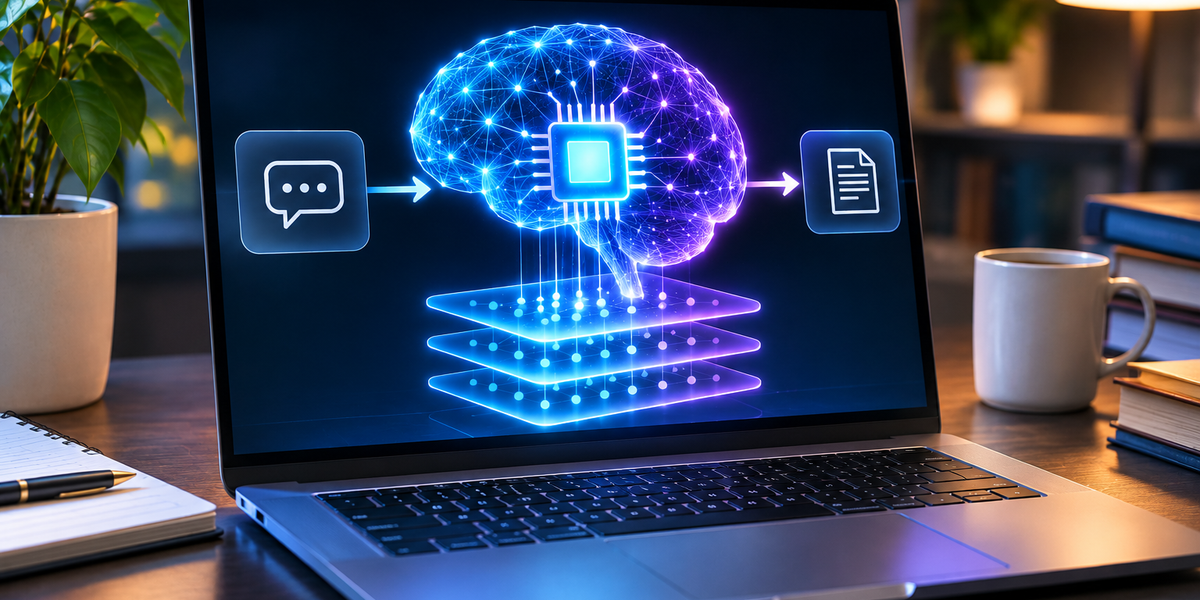
Information enters the network, passes through many transformations, and eventually produces an output.
During training, the strengths of the relationships inside the network are adjusted so that the system becomes better at producing desired results.
Imagine thousands of tiny adjustable dials inside a machine. At first, the dials are set poorly and the machine gives terrible answers. Training gradually adjusts them.
Real neural networks are vastly more complicated, and modern models can have billions of adjustable values, but the basic idea remains similar.
The model learns by adjusting its internal structure based on examples.
AI Doesn’t Store Everything Like a Database
One common misconception is that an AI chatbot contains a gigantic database of sentences and simply searches through them whenever you ask a question.
That’s generally not how a language model works.
A database might store an exact record such as a customer’s name, order number, and address. When software queries the database, it retrieves that stored information.
A trained AI model instead encodes patterns and relationships within its parameters.
This distinction matters because it explains both what AI is good at and why it sometimes fails.
A language model can generate a completely new sentence that may never have appeared in its training data because it has learned patterns about how language works. But because it isn’t simply looking up a verified database record every time it speaks, it can also generate something that sounds plausible but is false.
How Does an AI Chatbot Understand Your Question?
“Understand” is a tricky word here.
When you type a question, the model doesn’t necessarily understand it in the same conscious way a human does. Instead, your text is converted into smaller units called tokens.
Tokens can represent whole words, parts of words, punctuation, or other pieces of text.
The model processes those tokens and uses patterns learned during training to determine relationships among them and the context in which they appear.
If you write, “Write a polite email telling my manager I’ll be late,” the model recognizes patterns associated with emails, managers, lateness, politeness, and the structure of your request.
It then generates a response based on those relationships.
To you, it feels like the AI understood what you meant.
Technically, an enormous amount of statistical computation happened underneath.
Large Language Models Predict What Comes Next
One of the simplest ways to understand a large language model is as an extraordinarily sophisticated prediction system.
Imagine the sentence:
The capital of France is…
You can probably predict that the next word will be “Paris.”
Now imagine doing that kind of prediction across billions of examples involving history, programming, poetry, science, conversation, business writing, jokes, recipes, and countless other forms of text.
During training, a language model becomes extremely good at predicting which tokens are likely to come next given everything that came before them.
When generating a response, it repeatedly performs versions of this prediction.
It generates one token, then uses the updated context to generate another, then another, continuing until it produces the response.
This sounds almost too simple to explain systems capable of writing essays or solving problems. The remarkable part is what emerges when next-token prediction is performed by an enormous neural network trained on huge amounts of diverse information.
Why Doesn’t AI Always Give the Same Answer?
Language models don’t necessarily choose the single most likely next word every time.
They can generate from a range of plausible possibilities.
Suppose you ask an AI to complete:
The sunset looked…
Possible continuations might include “beautiful,” “orange,” “spectacular,” “strange,” or “like fire across the horizon.”
Several answers could make sense.
The model assigns different probabilities to possible continuations and, depending on how the system is configured, can select among them rather than always choosing exactly the same path.
That’s one reason generative AI can produce different answers to the same prompt.
It’s generating, not simply retrieving a fixed response.
What Is a Transformer?
Many modern language models use an architecture called a transformer.
Transformers became important because they are particularly effective at processing relationships within sequences of information, such as language.
A key concept is attention.
Attention helps a model determine which parts of the input are particularly relevant to other parts.
Consider the sentence:
Sarah gave Anna her laptop because she needed help fixing it.
Understanding words such as “she” and “it” requires considering relationships across the sentence.
Transformer models use attention mechanisms to weigh relationships among tokens and build representations of context.
In real systems, this happens across many layers and attention patterns simultaneously.
You don’t need to understand the equations behind attention to understand the purpose: it helps the model consider context rather than treating every word as an isolated object.
How Can AI Write About So Many Subjects?
Large language models are trained on extremely broad collections of text and other data, depending on the model.
During training, they encounter patterns associated with countless topics, writing styles, concepts, languages, and forms of reasoning.
That doesn’t mean the model contains a neat encyclopedia entry for every subject.
Instead, knowledge is distributed across the model’s parameters in complex ways.
When you ask about photosynthesis, for example, the model generates an answer using patterns it learned from material related to biology, scientific explanations, education, language, and many other sources.
When you ask for a children’s explanation of the same topic, it combines that subject knowledge with patterns associated with simpler vocabulary and educational writing.
This ability to combine learned patterns is one reason generative AI can be so flexible.
How Does AI Generate Images?
Image-generation systems work differently from language models, but the broad principle of learning patterns from data remains.
One common approach involves diffusion models.
During training, the system learns relationships between visual information and descriptions of that information. It also learns how to reverse a process in which noise is gradually added to images.
When generating an image, the system can begin with something resembling random visual noise and progressively transform it toward an image that matches the user’s request.
If you ask for “a small cabin beside a frozen lake under the northern lights,” the model uses learned relationships involving cabins, lakes, snow, lighting, composition, colors, and countless other visual concepts.
It isn’t necessarily retrieving one existing picture of that scene.
It’s generating a new arrangement based on patterns it learned during training.
How Does AI Recognize Images?
Image-recognition systems turn visual information into numerical representations that a model can process.
During training, the model learns patterns associated with shapes, textures, edges, objects, and increasingly complex visual relationships.
Earlier layers of a vision system might respond to relatively simple visual patterns. Deeper parts of the network can combine those signals into more sophisticated representations.
Eventually, the model can produce outputs such as “dog,” “traffic light,” or “possible fracture,” depending on what it was designed and trained to recognize.
Again, it isn’t seeing in the human sense.
It’s processing numerical representations of visual information and identifying learned patterns.
What Is Generative AI?
Traditional machine-learning systems often classify or predict something.
Is this email spam?
Is this transaction suspicious?
What product is this customer likely to buy?
Generative AI goes a step further by creating new outputs.
It can generate text, images, audio, video, software code, music, and other forms of content.
The model learns the patterns and structure of the type of data it was trained on and then uses those patterns to produce new examples.
That’s why it’s called generative AI.
Instead of only saying, “This is a picture of a dog,” it can potentially create a new picture of a dog.
Instead of only identifying that a paragraph is an email, it can write the email.
Why Does AI Sometimes Make Things Up?
One of the biggest limitations of generative AI is that a convincing answer isn’t necessarily a true answer.
Language models are trained to generate plausible sequences of language. Plausibility and factual accuracy often overlap, but they’re not identical.
If a model doesn’t have reliable information about something, it can still generate an answer that follows the patterns of what a good answer should sound like.
That can produce fabricated facts, nonexistent citations, incorrect dates, or confident explanations of things that aren’t true. These errors are often called hallucinations.
This is why important factual claims should be verified, particularly in medicine, law, finance, academic research, and other high-stakes areas.
Fluent language can create an illusion of certainty that the underlying information doesn’t deserve.
Why Can AI Seem Like It’s Reasoning?
Modern AI systems can often break problems into steps, compare options, analyze information, use tools, write code, and solve problems that weren’t explicitly shown during training.
This can look remarkably similar to reasoning.
Part of this ability emerges from learning enormous numbers of patterns involving how humans explain problems, draw conclusions, use logic, write arguments, and solve tasks.
More advanced AI systems can also be designed to spend additional computation on difficult problems, interact with external tools, retrieve information, execute code, or check aspects of their own outputs.
Whether this should be described as “thinking” in the human sense is a much larger philosophical and scientific question.
Practically, what matters is that modern models can perform tasks requiring multiple stages of inference while still making mistakes humans may find surprising.
Does AI Know Everything on the Internet?
No.
An AI model’s training data is not identical to the entire internet, and training doesn’t automatically give a model permanent access to every source it encountered.
A model can also have a knowledge cutoff or gaps in what it learned.
Some AI systems can use external tools to search the web, retrieve documents, access databases, run calculations, or interact with other software. In those situations, the model can combine its trained capabilities with current information.
That’s different from the model itself inherently knowing everything online.
This distinction is particularly important when asking about current events. A model may need access to an up-to-date information source before it can reliably tell you what happened today.
What Is Fine-Tuning?
After a general model has been trained, it can sometimes undergo additional training for a particular purpose.
This is called fine-tuning.
Imagine a model that already understands language broadly but needs to perform particularly well on a specialized task. Developers might train it further using examples relevant to that task.
Fine-tuning can help shape behavior, terminology, style, or domain-specific performance.
Other techniques can also be used to adapt models without retraining the entire system from scratch.
The important idea is that building an AI system doesn’t necessarily end with its initial training.
Models can go through several stages before reaching users.
How Do AI Assistants Become More Helpful?
A model that is simply good at predicting text isn’t automatically a useful assistant.
Developers can further train and configure models to follow instructions, refuse certain harmful requests, communicate clearly, use tools, and behave more helpfully.
Human feedback can also play a role.
People may evaluate different model responses and provide information about which ones are more useful, accurate, safe, or appropriate. Training techniques can then use those signals to improve future behavior.
This helps transform a raw language model into something that behaves more like an assistant.
Even then, the system isn’t perfect. AI behavior is partly probabilistic, and unexpected outputs remain possible.
AI Can Use Tools
An increasingly important development is that AI models don’t have to rely entirely on what was learned during training.
They can be connected to tools.
An AI system might search the web for current information, query a database, use a calculator, execute computer code, retrieve a company document, generate an image, or interact with another software service.
This changes what the system can do.
Imagine asking an AI, “What’s the weather in Tokyo right now?”
The model doesn’t need to have today’s weather stored in its parameters. It can use an external weather service, receive the current information, and explain the result.
In that situation, the model acts partly as an interface between you and other systems.
This is one reason AI assistants are becoming more capable without requiring the underlying model to memorize every piece of information they might ever need.
What Are AI Agents?
AI agents take the idea of tool use further.
Instead of responding to one prompt with one answer, an agent can potentially work through a goal involving multiple steps.
Suppose you ask an AI system to research hotels for a trip, compare prices, organize the options, and prepare an itinerary.
An agentic system might determine which steps are required, gather information using tools, evaluate results, and continue working toward the goal.
The exact definition of an “AI agent” varies across the technology industry, and the term is sometimes used very loosely.
But the general idea is that the AI does more than generate content. It can take or coordinate actions in pursuit of an objective.
AI Isn’t Magic, Even When It Feels Like It
The most surprising thing about modern AI isn’t that computers suddenly became magical.
It’s that learning patterns at enormous scale turned out to produce capabilities that are far more general than many people expected.
Underneath an AI conversation are tokens, numerical representations, neural networks, parameters, probability calculations, and enormous amounts of computation.
There isn’t a tiny person inside the computer writing the response.
There also isn’t necessarily a database containing the exact answer waiting to be retrieved.
The model processes your input, uses patterns encoded during training, and generates an output based on those patterns and the context available to it.
The Simple Version
If you want to understand modern AI without the mathematics, remember this.
Traditional software is usually programmed with explicit rules. Machine-learning systems learn useful patterns from examples. Neural networks provide a structure for learning complex relationships. Training adjusts enormous numbers of internal parameters until the model becomes better at its task.
Language models learn patterns in language and generate text by predicting what should come next based on context. Image models learn patterns in visual data and can use those patterns to create new images. More advanced AI systems can connect models to external information, software, and tools.
None of this means AI thinks exactly like a human.
It means we’ve built machines that can learn extraordinarily complicated patterns from data and use those patterns to produce useful new outputs.
The mathematics underneath may be difficult.
The basic idea isn’t.
Show a machine enough patterns, give it a way to learn from them, and it can become surprisingly good at predicting what should come next.