The Real Difference Between AI, Machine Learning, and Deep Learning
Artificial intelligence, machine learning, and deep learning are often used as though they mean the same thing. A company launches an AI feature. A researcher describes a machine-learning model. A new app claims to use deep learning. Then the same technology gets described with all three terms depending on who’s talking about it.
They’re closely related, but they aren’t interchangeable.
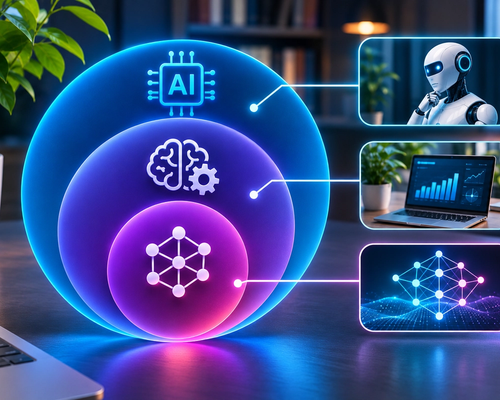
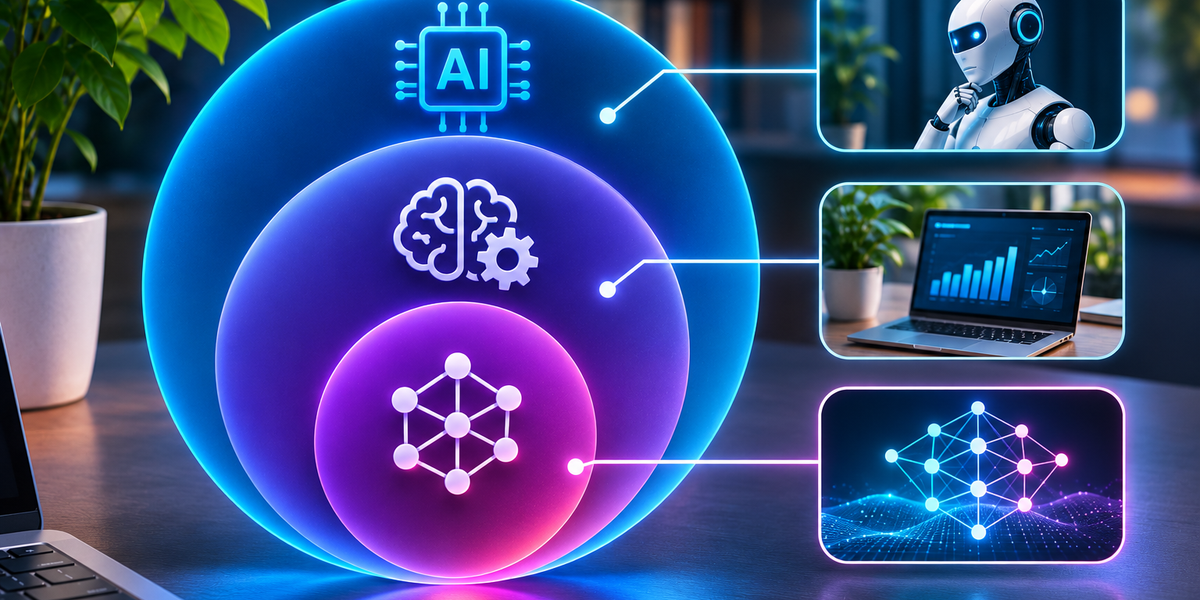
The easiest way to understand the relationship is to imagine three circles sitting inside one another. Artificial intelligence is the broadest category. Machine learning is one approach to artificial intelligence. Deep learning is a particular type of machine learning.
So all deep learning is machine learning, and all machine learning can be considered part of the broader field of AI. But not every AI system uses machine learning, and not every machine-learning system uses deep learning.
That distinction sounds small, but it makes the entire AI landscape much easier to understand.
Artificial Intelligence Is the Big Idea
Artificial intelligence, or AI, is the broadest term of the three. It describes the field of creating computer systems capable of performing tasks that we associate with intelligent behavior.
Those tasks can include understanding language, recognizing objects, solving problems, planning actions, making recommendations, playing games, generating images, or making decisions based on information.
Importantly, AI doesn’t describe one particular technology.
It’s an umbrella term covering many different approaches.
Imagine a computer program that plays chess. If it evaluates possible moves and chooses strategically useful ones, we might describe it as an artificial intelligence system. But that doesn’t necessarily mean it learned how to play chess from millions of games. Developers could have programmed rules and strategies directly into the software.
That would still fall within the broader history of AI.
This is why artificial intelligence existed long before today’s machine-learning boom.
AI Is Older Than You Might Think
AI can feel like an invention of the 2020s because tools such as generative AI suddenly made the technology visible to millions of people.
But researchers have been working on artificial intelligence for decades.
Early AI systems often relied heavily on rules created by humans. Developers tried to represent knowledge explicitly and tell computers how to reason about it.
For example, an expert system designed to help diagnose equipment problems might contain thousands of rules such as: if this symptom occurs together with these readings, investigate this component.
The computer could appear intelligent because it could process those rules much faster than a person.
But it wasn’t necessarily learning.
That distinction leads directly to machine learning.
Machine Learning Lets Computers Learn From Data
Machine learning is an approach to AI in which computer systems learn patterns from data instead of relying entirely on rules manually written by programmers.
Imagine you’re trying to build a system that identifies fraudulent credit-card transactions.
You could attempt to manually define every possible sign of fraud. Transactions over a certain amount might be suspicious. Purchases in an unusual country might be suspicious. Several transactions within seconds might be suspicious.
But fraud constantly changes, and legitimate behavior can be complicated.
Machine learning offers another approach.
You can provide the system with large amounts of historical transaction data, including examples of legitimate and fraudulent activity. The system analyzes patterns associated with those examples and builds a model capable of making predictions about new transactions.
Instead of a programmer writing every fraud rule directly, the model learns useful relationships from data.
That’s the central idea behind machine learning.
A Simple Machine-Learning Example
Imagine you want to predict the price of a house.
You collect information about thousands of previous home sales, including the size of each property, number of bedrooms, location, age, condition, and final sale price.
A machine-learning algorithm analyzes those examples and learns relationships between the characteristics of a home and its price.
You then provide information about a house the system has never seen before.
Based on the patterns it learned, the model predicts what that house might be worth.
The developer didn’t need to write a rule saying that every additional bedroom adds exactly a particular amount to the price.
The model learned relationships from examples.
Of course, real housing markets are complicated, and predictions can be wrong. But the example demonstrates the fundamental difference between traditional rule-based programming and machine learning.
Machine Learning Is Already Everywhere
You probably interact with machine-learning systems every day without noticing.
Email providers can use machine learning to identify spam. Banks can use it to detect unusual transactions. Streaming services can use it to recommend movies. Online stores can use it to predict products you might like. Navigation apps can use predictive models to estimate traffic conditions.
Machine learning is also used in manufacturing, cybersecurity, medicine, logistics, advertising, agriculture, scientific research, and countless other fields.
Not all of these systems look like the AI chatbots people now associate with artificial intelligence.
A machine-learning model might simply output a number.
It might predict that a customer has a 72% chance of canceling a subscription.
It might classify an email as spam.
It might estimate how many products a store should order next week.
These are all examples of machine learning even though nobody is having a conversation with the system.
So Where Does Deep Learning Fit?
Deep learning is a particular type of machine learning built around neural networks with many layers.
That’s where the word deep comes from.
A neural network is a mathematical structure loosely inspired by the idea of interconnected neurons in biological brains. Artificial neural networks aren’t miniature human brains, but the terminology reflects some of that original inspiration.
Information enters the network and passes through layers of computational units. Each layer transforms the information before passing it onward.
During training, the network adjusts enormous numbers of internal parameters so it becomes better at producing useful outputs.
When neural networks contain many processing layers, we generally enter the territory of deep learning.
Why Did Deep Learning Become Such a Big Deal?
Traditional machine-learning systems can perform extremely well, but they often depend heavily on humans deciding which features of the data are important.
Suppose you want a system to recognize faces in photographs.
With older approaches, engineers might spend considerable effort designing features that capture useful visual characteristics. They would decide which aspects of an image the algorithm should examine.
Deep learning can learn increasingly complex representations directly from large amounts of data.
In an image-recognition system, early parts of a neural network might respond to relatively simple patterns such as edges or textures. Deeper layers can combine those patterns into increasingly complex representations associated with shapes, objects, faces, or other visual concepts.
The system learns which representations are useful during training.
This ability to learn complex features automatically is one reason deep learning became so powerful for images, language, speech, and other forms of complicated data.
Deep Learning Needs a Lot of Data and Computing Power
Deep learning didn’t suddenly become possible because someone discovered neural networks yesterday. Many foundational ideas have existed for decades.
What changed was the environment around them.
The world began producing enormous amounts of digital data. Computing hardware became dramatically more powerful. Graphics processing units, or GPUs, proved particularly useful for the kinds of parallel calculations involved in training neural networks.
Cloud computing made large-scale computational resources easier to access. Researchers also developed better training techniques and model architectures.
Put those developments together, and neural networks could become much larger and learn from much more data.
The results improved dramatically.
AI, Machine Learning, and Deep Learning as Three Nested Boxes
One useful way to remember the relationship is to imagine three boxes.
The largest box is artificial intelligence. It contains technologies designed to perform tasks associated with intelligence.
Inside that is machine learning. These are AI systems that learn patterns from data.
Inside machine learning is deep learning. These systems use deep neural networks to learn complex patterns.
An old rule-based chess program might be AI without machine learning.
A model predicting house prices might use machine learning without deep learning.
A modern image-generation model might rely heavily on deep learning.
All three can reasonably be discussed as AI, but they’re using the term at different levels of specificity.
What About Generative AI?
Generative AI introduces another term into the mix.
Generative AI refers to systems designed to create new content, such as text, images, audio, video, or computer code.
Many of today’s most powerful generative AI systems are built using deep learning.
Large language models, for example, generally use deep neural-network architectures trained on enormous amounts of data. Image generators also commonly rely on deep-learning techniques.
This means a modern AI chatbot can simultaneously be described as artificial intelligence, machine learning, deep learning, and generative AI.
Those descriptions aren’t contradictory.
They’re describing different aspects of the same system.
It’s similar to describing someone as a person, a doctor, a surgeon, and a heart specialist. Each label becomes more specific.
Where Do Large Language Models Fit?
Large language models, or LLMs, are a type of deep-learning model designed to work with language.
During training, they learn statistical patterns from enormous amounts of text and other relevant data. They learn relationships among words, phrases, concepts, styles, and structures.
When you ask a language model a question, it processes your input and generates a response based on patterns encoded in its parameters.
The model isn’t simply searching through a database for a paragraph that matches your question.
It’s generating an answer based on what it learned during training and whatever additional context or tools may be available.
So the hierarchy looks roughly like this: an LLM is a deep-learning model, deep learning is part of machine learning, and machine learning sits within the broader field of artificial intelligence.
What About Chatbots?
Not every chatbot is the same kind of AI.
Older chatbots often relied heavily on predefined rules.
If the user typed a particular phrase, the system selected a corresponding response. Developers had to anticipate the kinds of things users might say and create conversation paths in advance.
Modern generative AI chatbots work very differently.
They can use large language models to generate responses dynamically rather than selecting everything from a fixed script.
Both systems might be called chatbots, and both might be described as AI in a broad sense, but the technology underneath them can be radically different.
This is another reason the term “AI” alone doesn’t tell you very much about how a product actually works.
Does Machine Learning Mean a Computer Is Learning Like a Human?
Not really.
The word “learning” can create the wrong mental image.
A machine-learning model doesn’t necessarily understand a lesson, experience curiosity, or consciously realize that it made a mistake.
Instead, learning refers to a mathematical optimization process.
The system makes predictions. Those predictions are compared with desired outcomes or other training signals. The model’s internal parameters are adjusted to improve performance.
This process can happen millions or billions of times.
Eventually, the model becomes very good at identifying certain patterns.
Calling that “learning” is useful terminology, but it shouldn’t automatically be interpreted as human-style learning.
Deep Learning Doesn’t Mean Deep Thinking
The word “deep” causes similar confusion.
Deep learning doesn’t mean the AI thinks particularly deeply about a problem.
It refers primarily to the structure of the neural network and its multiple computational layers.
A deep-learning system can perform an extremely sophisticated task without possessing human-style understanding of what it’s doing.
Likewise, a relatively simple machine-learning algorithm can sometimes outperform a deep neural network on a particular problem.
“Deep” isn’t automatically synonymous with “better.”
The right approach depends on the task, the available data, the computational resources, and many other factors.
When Traditional Machine Learning Can Be Better
Because deep learning dominates conversations about modern AI, it’s easy to assume companies should use neural networks for everything.
They shouldn’t.
Traditional machine-learning methods can be excellent for structured data such as spreadsheets containing customer characteristics, transaction histories, prices, or business metrics.
These models can be faster to train, cheaper to run, easier to interpret, and effective with smaller datasets.
If a straightforward model solves the problem accurately, using a giant neural network may add unnecessary complexity.
AI development isn’t a competition to use the most impressive technology.
It’s about choosing the right method for the problem.
Why Deep Learning Is So Good at Images and Language
Images, speech, and natural language contain enormous amounts of complex, unstructured information.
A photograph can contain millions of pixel values. A spoken sentence contains timing, frequency, pronunciation, background noise, and context. Language contains relationships that can stretch across entire paragraphs or documents.
Writing explicit rules for every possible pattern is practically impossible.
Deep neural networks can learn representations from large datasets without humans manually defining every relevant feature.
That’s one reason deep learning has driven major advances in image recognition, speech recognition, machine translation, language generation, and computer vision.
The system learns useful patterns at many levels of complexity.
What Is Supervised Learning?
Machine learning itself contains several different approaches.
In supervised learning, the model learns from examples that include some form of desired answer or label.
Imagine training a system to recognize dogs and cats.
You provide thousands of images labeled “dog” or “cat.”
The model makes predictions, compares them with the correct labels, and adjusts itself to become more accurate.
Eventually, you can show it a new image and ask it to classify the animal.
The supervision comes from the fact that the training examples provide information about the desired result.
What Is Unsupervised Learning?
In unsupervised learning, the data doesn’t necessarily come with explicit labels telling the model the correct answer.
Instead, the system looks for useful structure or patterns within the data.
Imagine giving a model information about thousands of customers without telling it what kinds of customers exist.
The algorithm might identify groups with similar purchasing behavior.
One group might buy frequently but spend small amounts. Another might shop rarely but make expensive purchases.
Nobody necessarily told the system those categories in advance.
It identified patterns in the data.
What Is Reinforcement Learning?
Reinforcement learning uses a different idea.
An agent interacts with an environment and receives signals based on the consequences of its actions.
Actions that lead to desirable outcomes receive positive signals or rewards, while undesirable outcomes may receive lower rewards or penalties.
Over time, the system learns strategies that produce better results.
A simple analogy is training a dog with rewards, although actual reinforcement-learning systems are mathematical rather than biological.
Reinforcement learning has been used in areas such as robotics, game-playing systems, optimization, and parts of modern AI training.
Why These Terms Get Mixed Up
The confusion is partly understandable because modern AI systems often use all of these technologies simultaneously.
A company might say it has launched an “AI recommendation system.”
Technically, the system might use machine learning.
More specifically, it might use a deep neural network.
All three descriptions can be correct.
The difference is how specific you’re being.
“AI” describes the broad category.
“Machine learning” describes an approach used within AI.
“Deep learning” describes a particular family of machine-learning methods.
Marketing makes the distinction even blurrier because “AI” is the term most people recognize. Companies may describe almost any predictive or automated system as AI because it sounds more impressive than explaining the underlying algorithm.
Why the Difference Matters
Understanding these terms helps you evaluate claims about technology more critically.
If a company says its product uses AI, that statement alone tells you very little.
What does the AI actually do?
Does it follow predefined rules?
Does it use a machine-learning model trained on historical data?
Does it use a deep neural network?
Does it generate new content?
Does it make predictions?
Does a human review its decisions?
These questions are much more useful than simply asking whether something “has AI.”
The same applies to discussions about AI risks and capabilities.
A recommendation algorithm, an autonomous vehicle system, a fraud-detection model, and a generative chatbot can all fall under the umbrella of artificial intelligence while behaving very differently.
The Simplest Way to Remember It
Think of artificial intelligence as the entire field.
AI is the goal of building machines capable of performing tasks associated with intelligent behavior.
Machine learning is one major way of achieving that goal by allowing systems to learn patterns from data instead of programming every rule manually.
Deep learning is a specialized form of machine learning that uses multilayer neural networks to learn especially complex patterns.
So the relationship is:
Artificial intelligence → Machine learning → Deep learning.
Generative AI, large language models, computer vision systems, recommendation engines, and many other technologies can sit somewhere within or across those categories.
The terminology sounds complicated because the systems themselves can be complicated.
But the basic distinction isn’t.
AI is the big idea. Machine learning is one way to achieve it. Deep learning is one powerful way to do machine learning.
Once you understand that hierarchy, much of the confusing language surrounding modern AI suddenly becomes a lot easier to decode.