The Gadgets Worth Buying (And the Ones That Are a Waste)
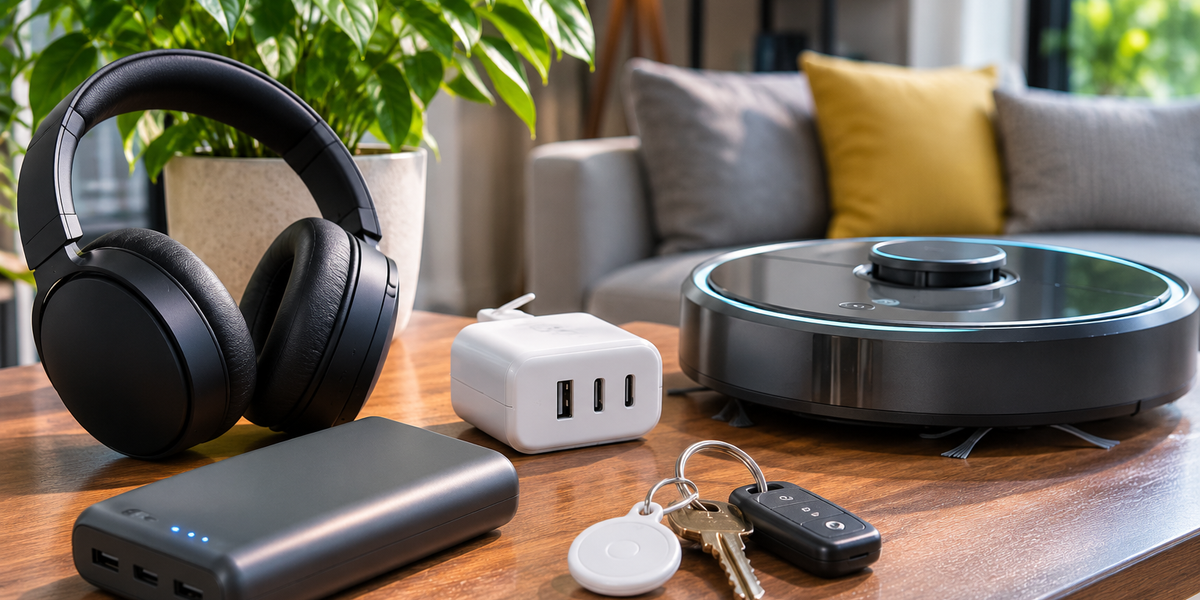
Technology companies are extremely good at convincing us that one more gadget will make life easier.
A smart water bottle will remind you to drink. A tiny Bluetooth tracker will make sure you never lose your keys. A sleep device will finally fix your mornings. A miniature kitchen appliance will transform dinner. A new wearable will tell you things about your body you apparently couldn’t survive without knowing.
Some gadgets genuinely do make everyday life better.
Others spend three exciting weeks on your kitchen counter before beginning their permanent migration toward a drawer.
The difference usually has very little to do with how futuristic the technology is. The gadgets worth buying tend to solve a real problem repeatedly, require very little effort to use, and fit naturally into something you already do. The bad ones often create a new routine, subscription, charging requirement, or app simply to solve a problem you barely had.
So before buying another piece of technology, forget how impressive it looks in the advertisement.
Ask a much less exciting question:
Will this actually make my normal Tuesday better?
That’s a surprisingly effective way to separate useful technology from expensive clutter.
Worth It: A Good Power Bank
A power bank is one of the least glamorous gadgets you can buy, which is exactly why it’s so useful.
Phones have become wallets, cameras, maps, boarding passes, translators, authentication devices, communication tools, and entertainment systems. When your battery dies while you’re away from a charger, you don’t simply lose the ability to make a phone call.
You can lose access to half your day.
A good portable battery solves that problem directly.
You charge it, put it in your bag, and use it when necessary. There is almost no learning curve, no complicated setup, and usually no subscription.
That’s the kind of gadget worth paying for.
It solves a predictable problem with very little friction.
The mistake is buying an enormous power bank because it has the biggest number on the box. Capacity matters, but so do weight, charging speed, ports, and whether you’ll actually carry it.
A smaller power bank that’s always in your bag is more useful than a giant one sitting at home.
Worth It: Noise-Canceling Headphones
If you regularly travel, commute, work in shared spaces, or simply live somewhere noisy, good active noise-canceling headphones can be genuinely transformative.
They don’t just make music sound better.
They reduce the amount of background noise competing for your attention.
On an airplane, they can reduce the constant low-frequency engine noise. In an office, they can make concentration easier. On a train, they can allow you to listen at a more comfortable volume instead of turning the sound up to overpower your surroundings.
They’re particularly valuable because their usefulness isn’t based on novelty.
If noise bothers you today, it will probably bother you next year too.
That’s a good sign when evaluating a gadget.
The best technology often solves an old problem rather than inventing a new one.
Worth It: A Bluetooth Tracker for Things You Actually Lose
A Bluetooth tracker attached to your keys, bag, luggage, or another frequently misplaced item can save a ridiculous amount of frustration.
The key is using trackers selectively.
If you regularly spend ten minutes searching for your keys before leaving home, attaching a tracker solves a real recurring problem.
If you’ve never lost your backpack in your life, putting a tracker on it because the internet told you to may not add much value.
Trackers work best when attached to something that would be genuinely inconvenient or expensive to lose.
They’re a perfect example of technology that doesn’t need to be revolutionary.
Saving you from one airport-luggage panic or several mornings searching under sofa cushions may be enough to justify the purchase.
Worth It: A Multi-Port Fast Charger
Many people have accumulated a small museum of chargers.
One for the laptop.
One for the phone.
One for the tablet.
Another for headphones.
Several mystery cables whose original purpose disappeared years ago.
A high-quality multi-port charger can replace much of that clutter.
Modern chargers can often provide enough power for several devices while remaining surprisingly compact. For people who travel regularly, one charger that handles a laptop, phone, watch, headphones, and other accessories can eliminate an entire bag of adapters.
This is another good example of a worthwhile gadget because it simplifies something you’re already doing.
It doesn’t add a new technological habit.
It removes several.
Worth It: A Robot Vacuum—For the Right Home
Robot vacuums sit somewhere between genuinely useful technology and very expensive entertainment for your cat.
Whether one is worth buying depends heavily on your home.
If you have mostly accessible floors, regularly deal with crumbs, dust, pet hair, or children’s messes, and don’t want to vacuum constantly, a robot can remove a repetitive household task.
The biggest benefit isn’t that it cleans better than a person with a good vacuum.
It’s that it can clean more frequently without requiring you to do the work every time.
That distinction matters.
A robot vacuum that runs regularly can keep everyday dirt under control while you occasionally handle deeper cleaning yourself.
But the technology becomes less useful in homes filled with stairs, high thresholds, loose cables, complicated furniture, or objects constantly left on the floor.
A robot vacuum doesn’t magically eliminate cleaning.
It automates one particular part of it.
If that part is already annoying you several times a week, it may be worth every cent.
Worth It: An E-Reader for People Who Actually Read
An e-reader is one of the rare gadgets that can do less than your phone and be better because of it.
You can’t meaningfully scroll social media, answer Slack messages, watch short videos, or fall into an hour-long internet rabbit hole.
You mostly read.
That’s the point.
E-ink displays are designed to resemble printed pages more closely than conventional bright screens, and dedicated e-readers can hold large libraries while remaining small enough to travel with easily.
For someone who reads several books a year, travels frequently, or constantly runs out of physical shelf space, an e-reader can be an excellent purchase.
For someone who reads one book every three years and likes the idea of being a reader more than the actual reading part, it may become a very elegant object on the nightstand.
The device isn’t the habit.
That’s worth remembering whenever technology promises to create one for you.
Worth It: A Smartwatch—If You Know Why You Want One
Smartwatches can be extremely useful.
They can provide navigation, notifications, timers, contactless payments, workout tracking, safety features, and quick access to information without requiring you to pull out your phone.
But they’re also one of the easiest gadgets to buy without a clear reason.
The question isn’t whether a smartwatch has useful features.
It almost certainly does.
The question is whether those features improve your life enough to justify another device that needs charging, updating, and occasionally interrupting you.
Someone who runs regularly, uses navigation while walking, wants convenient timers and payments, or values certain safety features may use a smartwatch constantly.
Someone who buys one primarily because everyone else has one may eventually realize they’ve spent hundreds of euros to receive phone notifications on a smaller screen.
Buy it for specific functions, not because “wearable technology” sounds useful.
Worth It: A Portable SSD
Cloud storage is incredibly convenient, but sometimes you want a large amount of data physically available.
That’s where a portable solid-state drive becomes useful.
A good portable SSD can hold backups, photographs, videos, work files, and large projects while remaining small enough to carry easily.
For photographers, video editors, designers, researchers, travelers, and anyone working with large files, it can be an extremely practical tool.
It can also provide another layer of backup.
That’s important because “my laptop contains the only copy” is not a backup strategy.
The average person may not need several terabytes of portable storage. But if you regularly move large files or want an offline copy of important information, a portable SSD is one of those boring purchases you’ll probably appreciate much longer than whatever smart gadget is currently trending.
Worth It: A Proper USB-C Hub
Modern laptops have become beautifully thin.
Unfortunately, some achieved this elegance by apparently declaring war on ports.
If your computer doesn’t have enough connections for the equipment you actually use, a good USB-C hub or dock can solve the problem neatly.
One device can provide additional USB ports, memory-card readers, monitor connections, Ethernet, and power delivery.
For people who use a laptop as both a portable computer and a desk workstation, a dock can be particularly useful.
You arrive at your desk, connect one cable, and suddenly your laptop has power, monitors, storage, networking, keyboard, mouse, and other accessories.
Again, this is technology at its best.
It removes friction from something you already do.
Worth It: A Simple Smart Plug
Not every smart-home device needs to involve an elaborate ecosystem.
A smart plug can be useful precisely because it’s simple.
Plug a lamp, fan, or another appropriate appliance into it and you can schedule when power turns on or off, control it remotely, or integrate it with basic routines.
The value depends entirely on whether you have a real use for it.
If you regularly walk downstairs because you forgot to turn off a lamp, automation may genuinely help.
If you’re buying ten smart plugs because you’re excited about having a “smart home,” you may be creating more complexity than you’re removing.
The best smart-home technology quietly disappears into your routine.
You shouldn’t have to become the IT department of your own living room.
Maybe Worth It: A Smart Speaker
Smart speakers are incredibly convenient for certain households.
Voice-controlled timers while cooking are useful. So are music, weather information, reminders, basic questions, and smart-home controls.
But their value depends heavily on how much you actually use voice interaction.
Some people integrate smart speakers naturally into everyday life.
Others enthusiastically install one in every room and six months later use them almost exclusively to ask what time it is.
There’s also the question of ecosystem dependence.
Connected products can rely on software support, cloud services, accounts, and compatible apps. If those disappear, a physically functional device can lose features or become unusable. Consumer guidance therefore increasingly recommends checking how long manufacturers promise software and security support and whether a smart product can still perform its core function without an internet connection. (Umweltbundesamt)
That’s a useful rule for smart gadgets generally.
The more dependent a product is on someone else’s server, the more you should care about how long that server will exist.
Maybe Worth It: A Tablet
Tablets are fantastic devices.
They’re also unnecessary for plenty of people.
A tablet can be excellent for reading, drawing, watching video, handwritten notes, presentations, travel, children’s entertainment, or lightweight work.
But before buying one, ask what it will do that your existing phone and laptop don’t already do well enough.
If you can answer that immediately, great.
If your answer is something vague like “It might be useful,” be careful.
Technology purchases often begin with imagining the person we’re going to become after buying the device.
We’ll journal every morning.
We’ll sketch.
We’ll read academic papers.
We’ll finally organize our life.
Then the tablet becomes a very expensive Netflix screen.
Buy for the habits you already have, not the imaginary person a gadget advertisement suggests you might become.
Maybe Worth It: A Fitness Tracker
Fitness trackers can make movement more visible.
Seeing your steps, workouts, trends, or other measurements can help some people stay consistent.
But more data isn’t automatically more useful.
If you check your numbers, understand what they mean, and use them to support realistic habits, a tracker can be valuable.
If you obsess over the numbers without changing anything—or feel guilty whenever the device tells you that you didn’t meet an arbitrary goal—the gadget isn’t necessarily improving your life.
There’s also a tendency to assume that because a device measures something, the measurement must be important.
That’s not always true.
A metric is useful when it helps you make a useful decision.
Otherwise, it’s just another number on a screen.
Usually a Waste: Single-Purpose Smart Kitchen Gadgets
The kitchen has become one of the favorite places to add unnecessary Wi-Fi.
There are smart kettles, connected scales, app-controlled coffee equipment, smart containers, connected thermometers, and increasingly complicated versions of appliances that worked perfectly well before anyone added Bluetooth.
Some of these products are excellent.
A good cooking thermometer, for example, can solve a real problem.
The warning sign is when the “smart” feature adds more effort than it removes.
If you need to unlock your phone, open an app, wait for a connection, install an update, and navigate three screens to perform something that used to require pressing one button, technology has gone in the wrong direction.
Not every object becomes better when connected to the internet.
Sometimes a kettle should simply boil water.
Usually a Waste: Cheap Novelty Electronics
Tiny projectors. Mini printers. Pocket fans. Random LED gadgets. Ultra-cheap wireless earbuds. USB devices with one strangely specific function.
Some are genuinely useful.
Many are purchased because they’re inexpensive enough that we don’t think very hard before clicking Buy.
That has created what some researchers and recycling organizations now describe as “fast tech”: inexpensive electronic products that are purchased frequently and often used for short periods. A 2026 survey commissioned by the WEEE Forum across 12 European countries found that almost 90% of respondents owned at least one such device, while many reported products being discarded after very limited use. (WEEE Forum)
The €12 gadget doesn’t feel like a major purchasing decision.
That’s exactly why drawers fill with them.
A useful rule is to wait a few days before buying inexpensive electronics you hadn’t planned to purchase.
If you’ve forgotten about the gadget by then, you’ve probably answered the question.
Usually a Waste: Gadgets That Duplicate Your Phone Poorly
Your smartphone is already a calculator, scanner, flashlight, voice recorder, GPS navigator, camera, timer, alarm clock, music player, notebook, translator, remote control, and much more.
A separate gadget needs to do one of those things significantly better to justify existing in your bag.
A dedicated camera can absolutely outperform a phone for certain photography.
A serious GPS device can make sense for specialized outdoor use.
A good voice recorder can be valuable professionally.
But a mediocre standalone device that reproduces something your phone already does perfectly well usually creates more clutter than value.
Before buying, ask:
Does this solve a problem my phone genuinely can’t solve?
If the answer is no, you probably don’t need another battery to charge.
Usually a Waste: Smart Versions of Things That Didn’t Need to Be Smart
The technology industry has spent years asking whether things can connect to the internet without always asking whether they should.
Smart mirrors.
Connected water bottles.
App-controlled toothbrushes.
Bluetooth luggage.
Internet-connected kitchen appliances.
Smart forks.
Some people will find specific versions genuinely useful, and accessibility needs can completely change the value of a feature.
But for the average buyer, every connected feature creates another potential dependency.
There may be an app.
An account.
Software updates.
A cloud service.
Compatibility requirements.
Privacy considerations.
A battery.
A wireless connection that occasionally decides it no longer wants to cooperate.
If the connected feature doesn’t meaningfully improve the product’s primary function, the simpler version is often the better purchase.
Usually a Waste: The Gadget That’s Supposed to Create a Habit
This is perhaps the biggest category of wasted technology.
You buy a smartwatch because you’re going to start exercising.
You buy an e-reader because you’re going to start reading.
You buy an expensive blender because you’re going to make smoothies every morning.
You buy a tablet because you’re going to become organized.
You buy a sleep tracker because you’re finally going to fix your sleep schedule.
Sometimes the gadget helps.
But technology is much better at supporting existing behavior than creating entirely new behavior.
Before spending money, try the habit without the gadget.
Read regularly for a month using books or your phone.
Start running before buying the expensive watch.
Make smoothies using the blender you already own.
If the habit sticks and you can clearly identify how better equipment would improve it, buy the gadget.
Now you’re upgrading a real behavior instead of purchasing an aspiration.
Be Suspicious of Subscriptions
One of the biggest changes in consumer technology is that buying the hardware doesn’t always mean you’ve finished paying.
Some gadgets require subscriptions for cloud storage, advanced analytics, premium features, historical data, AI functions, or functionality that feels suspiciously close to the reason you bought the device in the first place.
A €150 gadget accompanied by a €10 monthly subscription isn’t really a €150 gadget.
Keep it for three years and you’ve spent another €360.
Before buying connected technology, calculate the total cost over several years.
Then ask whether you would still buy it at that price.
Subscriptions aren’t inherently bad. Maintaining cloud infrastructure and ongoing services costs money.
But recurring fees should provide recurring value.
Don’t Upgrade Just Because a New Version Exists
One of the easiest ways to waste money on technology is replacing devices that still solve your problems.
A new phone may have a faster processor, improved camera, brighter screen, and new AI features.
Those improvements can be real.
But if your current phone already takes photographs you like, runs your apps smoothly, lasts through the day, and still receives security updates, the practical difference may be much smaller than the marketing difference.
Longer device lifespans also reduce waste and the environmental impact associated with manufacturing new electronics. Consumer and environmental guidance consistently recommends keeping devices in use longer, repairing them where practical, and considering refurbished equipment rather than automatically replacing functioning hardware. (Verbraucherzentrale)
The best upgrade cycle isn’t every year, two years, or three years.
It’s when your current device no longer meets your needs.
Repairability Matters More Than It Looks
A gadget can be excellent on the day you buy it and frustrating two years later if one failing component makes the entire product disposable.
Batteries are particularly important because rechargeable batteries naturally lose capacity over time.
Before buying expensive electronics, it can be worth checking whether the battery can be replaced, whether replacement parts exist, whether repairs are realistically available, and how long the manufacturer promises software support.
These details aren’t exciting enough for advertisements.
But they’re often what determines whether a gadget lasts two years or six.
The boring specifications can be more important than the headline features.
The Five-Minute Test Before Buying Any Gadget
Before buying something, imagine the device six months from now.
Where will it physically live?
How often will you use it?
What specific task will it replace?
Does it require charging?
Does it require another app?
Does it require a subscription?
Does it still work if the manufacturer stops supporting the software?
Do you already own something that performs the same job?
Most importantly, what problem are you currently experiencing that this gadget solves?
If you struggle to answer that last question, don’t buy it yet.
A product shouldn’t have to teach you what problem you have.
Spend More on Things You Use Constantly
Price alone doesn’t determine whether something is a waste.
A €300 pair of headphones you use three hours every day may provide far more value than a €30 gadget you use twice.
This is why cost per use is a useful way to think about technology.
Suppose you spend €200 on something you use every working day for four years.
That’s roughly €0.20 per working day.
Now imagine spending €40 on a novelty gadget you use twice.
That’s €20 per use.
The cheaper object was actually the expensive purchase.
Instead of asking whether a gadget costs a lot, ask whether you’ll use it enough for the cost to make sense.
The Best Gadget Is Often the One You Already Own
Technology marketing depends on making your current devices feel obsolete.
But most improvements happen gradually.
Your three-year-old laptop didn’t become slower because a new laptop was announced.
Your headphones didn’t suddenly sound worse because a newer version exists.
Your phone camera didn’t lose megapixels overnight.
If something already works well, continuing to use it is often the cheapest and simplest option.
It also avoids adding another electronic device to the enormous global waste stream created by discarded technology.
The smartest technology purchase is sometimes deciding not to purchase anything.
The Simple Rule
The gadgets worth buying usually have something in common.
They solve a problem you already experience.
You use them frequently.
They replace effort rather than adding complexity.
They work reliably.
They don’t require an unnecessary ecosystem of apps and subscriptions.
And you can explain exactly why you need them before you buy them.
The gadgets that become wastes usually begin with a different thought:
“This looks cool. I’m sure I’ll find a use for it.”
Maybe you will.
But if you want a better filter, ask yourself one question before pressing Buy:
What will I stop doing because I own this?
If a robot vacuum means you’ll vacuum manually less often, that’s clear.
If noise-canceling headphones mean you’ll struggle less to concentrate on flights, that’s clear.
If a multi-port charger means you’ll stop carrying four adapters, that’s clear.
If you can’t identify anything the gadget will replace, improve, or meaningfully simplify, there’s a good chance you’re not buying a solution.
You’re buying another object that needs charging.