How Wireless Charging Actually Works
Wireless charging feels almost suspiciously simple. You place your phone on a charging pad, hear a small sound, see the battery symbol change, and electricity somehow starts flowing into the device without a cable plugged into it.
But the electricity isn’t jumping through the air directly into your battery.
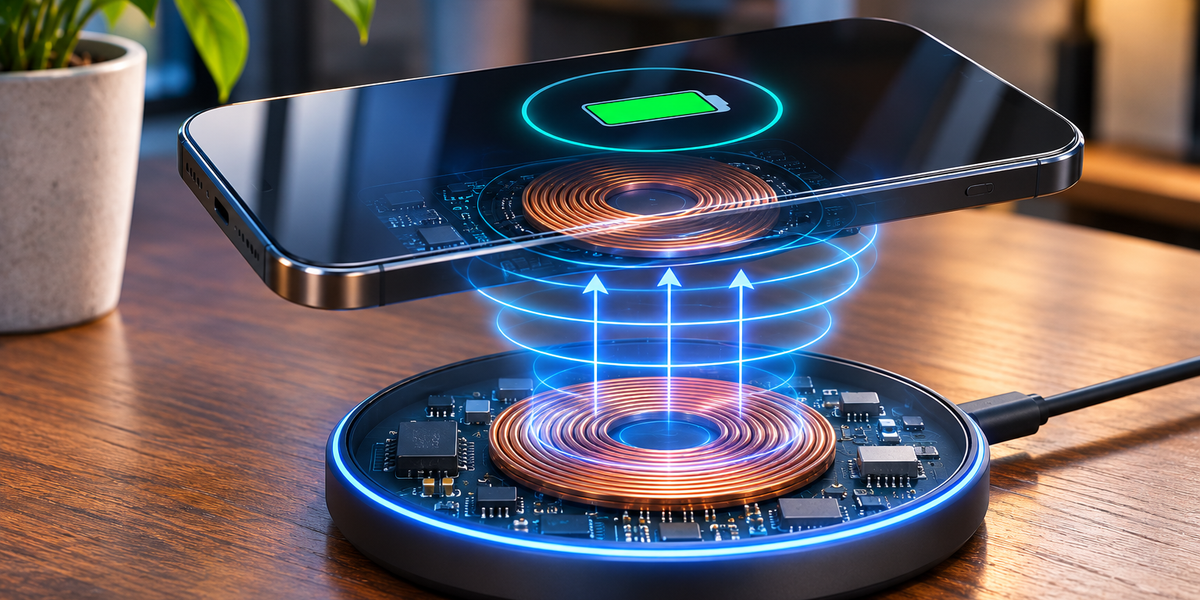
Wireless charging works by using electromagnetic fields to transfer energy across a very short distance. Inside both the charger and your phone are coils of wire. The charging pad creates a changing magnetic field, and the coil inside your phone uses that field to generate an electrical current.
That current can then be converted into the kind of electricity the phone needs to charge its battery.
The basic principle has existed for well over a century. Modern wireless charging simply packages it into something small, efficient, and smart enough to use safely on your bedside table.
It Starts With Electricity and Magnetism
Electricity and magnetism are closely connected.
When electric current flows through a wire, it creates a magnetic field around that wire. If you arrange the wire into a coil, the magnetic effect becomes more useful because the fields produced by the loops work together.
The relationship also works in the other direction.
A changing magnetic field near another coil of wire can cause an electric current to appear in that second coil.
This phenomenon is called electromagnetic induction.
Wireless chargers use exactly this principle.
The charging pad contains one coil.
Your phone contains another.
Energy moves from the first coil to the second through a changing magnetic field.
Think of It Like Two Coils Talking to Each Other
Imagine two coils of wire placed very close together.
The first coil is connected to a power source. Electricity flows through it in a carefully controlled way, producing a changing magnetic field.
The second coil isn’t physically connected to the first.
But because it’s sitting inside that changing magnetic field, an electrical current is induced inside it.
That’s the essential trick behind wireless charging.
The coils don’t need to touch.
They simply need to be close enough and aligned well enough for energy to transfer efficiently.
This is why your phone can charge through its back panel and even through many protective cases.
What Happens When You Put Your Phone on the Charger?
When you place a compatible phone on a wireless charging pad, several things happen very quickly.
The charger detects that a compatible device is present. It begins energizing its transmitter coil with alternating current.
That creates a rapidly changing magnetic field.
The receiving coil inside the phone sits within that field.
The changing magnetic field induces an alternating electrical current in the phone’s receiving coil.
The phone’s charging electronics then convert and regulate that electricity so it can safely charge the battery.
So the energy path looks roughly like this:
Electricity from the wall reaches the charging pad. The pad converts that electrical energy into a changing magnetic field. The phone’s coil converts part of that magnetic energy back into electrical energy. The phone’s power-management system then uses that electricity to charge the battery.
There is no invisible cable.
But there is still a very real transfer of energy.
Why Does the Charger Use Alternating Current?
A steady electrical current would create a relatively steady magnetic field.
But electromagnetic induction depends on a changing magnetic field.
That’s why the charging system drives the transmitter coil using alternating electrical current.
As the current changes direction and intensity, the magnetic field changes too.
That changing field is what allows the receiving coil in the phone to generate electricity.
The process happens extremely quickly—far too quickly for you to notice.
To you, the phone simply begins charging.
The Coils Have to Be Close
Wireless charging works best over very short distances.
That’s because the magnetic coupling between the transmitter and receiver becomes weaker as the distance increases.
Move the phone slightly above the charger and efficiency drops.
Move it far enough away and charging stops.
This is why today’s common wireless charging systems aren’t really “room-scale wireless electricity.” You can’t put a charging pad on one side of your bedroom and charge your phone from the other side.
The device usually needs to be placed directly on or extremely close to the charger.
The word “wireless” refers to the lack of a physical electrical connection between the charger and phone.
It doesn’t mean energy can travel efficiently across arbitrary distances.
Alignment Matters Too
If you’ve ever placed your phone slightly incorrectly on a wireless charger and discovered later that it barely charged—or didn’t charge at all—you’ve encountered one of the major limitations of inductive charging.
The transmitter and receiver coils need to overlap reasonably well.
If they’re badly misaligned, less of the magnetic field reaches the receiving coil.
That reduces efficiency and can increase heat.
This is why some wireless charging systems use magnets.
The magnets help position the device so the charging coils line up properly.
Better alignment means more reliable and efficient energy transfer.
Why Magnets Made Wireless Charging Better
Magnetic alignment doesn’t create the charging energy itself.
The coils still perform the actual energy transfer.
The magnets simply help place those coils in the correct position.
Think of trying to place two coins directly on top of each other while one is hidden under a sheet of paper. You can probably get close, but you may not align them perfectly every time.
Now imagine the coins automatically snapping into the correct position.
That’s essentially what magnetic alignment accomplishes for wireless charging.
It makes the experience more predictable.
Instead of carefully positioning your phone until charging begins, you can place it near the correct area and let the magnets help align it.
What Is Qi?
If you’ve looked at wireless chargers, you’ve probably seen the word Qi.
Qi is a widely used wireless charging standard developed by the Wireless Power Consortium.
A standard is important because the charger and device need to agree on how energy transfer and communication should work.
Without common standards, every manufacturer could create a completely different wireless charging system requiring its own chargers.
Qi provides a shared framework that allows many compatible devices and chargers to work together.
Modern versions of wireless charging standards have also incorporated improved magnetic alignment and higher-performance charging capabilities.
The underlying principle remains electromagnetic induction.
The Charger and Phone Actually Communicate
Wireless charging isn’t simply a charger blindly producing a magnetic field at maximum power whenever something is placed on top.
The charger and device can exchange information.
The phone can communicate information about how much power it needs and how charging should be controlled.
The charger can adjust its output accordingly.
This communication helps improve efficiency and safety.
As the battery fills, the phone’s charging system can change how much power it accepts.
If conditions become unsuitable, charging can slow down or stop.
So wireless charging is not merely electromagnetic physics.
It’s electromagnetic physics controlled by software and power-management electronics.
How Does the Charger Know a Phone Is There?
Wireless chargers can detect changes associated with objects placed near the charging coil.
When a compatible receiver is detected, the charger can begin a communication process to determine whether it should transfer power.
This matters because you don’t want the charger continuously operating at full power regardless of what’s sitting on it.
The charging system needs to distinguish between a compatible device and other objects.
That leads to another important feature: foreign object detection.
Why Metal Objects Can Be a Problem
Suppose you put a metal object between your phone and wireless charger.
A changing magnetic field can interact with conductive materials and generate electrical currents inside them.
Those currents can produce heat.
That’s why wireless charging systems include mechanisms designed to detect potentially problematic foreign objects.
If the charger determines that something is interfering with the power transfer, it may reduce power or stop charging.
This is one reason you shouldn’t casually place coins, keys, metal plates, or other conductive objects between a phone and wireless charging pad.
The system is designed to transfer energy to a compatible receiver, not heat random pieces of metal.
Why Wireless Charging Creates Heat
No energy-transfer system is perfectly efficient.
Some energy is inevitably lost.
With wireless charging, part of the electrical energy entering the charger becomes heat instead of useful energy stored in the battery.
Losses can occur in the charging coils, power electronics, magnetic coupling, and other parts of the system.
Poor alignment can increase those losses.
If the coils aren’t positioned properly, more energy may be wasted rather than successfully transferred.
That’s one reason wireless charging can make your phone and charging pad feel warm.
Some higher-powered wireless chargers even include active cooling systems to manage heat.
Why Heat Matters for Batteries
Smartphone batteries don’t particularly like excessive heat.
Lithium-ion batteries naturally degrade over time, and high temperatures can accelerate some forms of degradation.
That’s why modern phones carefully monitor battery and device temperatures while charging.
If the phone becomes too hot, the charging system may reduce power.
You may notice charging slow down even though the charger is theoretically capable of delivering more.
That’s not necessarily a malfunction.
The phone may be deliberately protecting the battery and other components.
Fast charging—whether wired or wireless—requires careful thermal management.
Is Wireless Charging Less Efficient Than a Cable?
Generally, wireless charging introduces additional energy losses compared with a direct wired connection.
With a cable, electricity travels through conductors directly into the device’s charging electronics.
Wireless charging adds extra conversion steps.
Electrical energy creates a magnetic field. That field transfers energy between coils. The receiving system converts it back into usable electrical energy.
Every conversion introduces opportunities for loss.
Alignment also matters. A poorly positioned phone may charge less efficiently than a perfectly aligned one.
This doesn’t make wireless charging inherently bad.
It simply means convenience comes with an efficiency trade-off.
Why Can Wired Charging Be Faster?
A cable can usually deliver power more directly and efficiently.
Modern wired charging standards can support very high power levels when the phone, cable, and charger are all compatible.
Wireless charging has additional challenges.
Higher power can generate more heat. Coil alignment becomes important. The charger and device must carefully control the transfer.
As wireless charging technology improves, the performance gap can shrink for compatible devices.
But wired charging remains attractive when maximum speed and efficiency are priorities.
Wireless charging’s biggest advantage is usually convenience.
What Happens When the Battery Reaches 100%?
Your wireless charger doesn’t simply keep forcing maximum power into a full battery forever.
The phone’s battery-management system controls the charging process.
As a lithium-ion battery approaches a high state of charge, the charging behavior changes.
Eventually, active charging can stop or reduce significantly.
If the battery level later falls slightly while the phone remains on the charger, the system can manage additional charging as needed.
Modern smartphones may also use optimized charging features that delay or limit charging under certain circumstances based on settings and usage patterns.
The important point is that the charging pad doesn’t independently decide how much energy the battery receives.
The phone’s internal charging electronics play a major role.
Does Leaving a Phone on a Wireless Charger Overnight Damage It?
Modern smartphones contain charging and thermal-management systems designed to prevent the battery from simply being continuously overcharged.
Once the battery reaches its target charge level, the phone manages the incoming power.
However, battery aging is more complicated than simply asking whether “overcharging” occurs.
Lithium-ion batteries generally age faster when exposed repeatedly to high temperatures and when they spend long periods at very high states of charge.
Because wireless charging can produce additional heat, temperature management matters.
For most people, occasional or routine overnight wireless charging is a convenience decision rather than something that instantly destroys the battery.
If you’re trying to maximize battery longevity over many years, keeping the phone cool and using available battery-health or optimized-charging features can be helpful.
Why Some Cases Work and Others Don’t
Wireless charging can pass through many phone cases because the magnetic field can travel through materials such as plastic, silicone, and glass.
But distance still matters.
A very thick case increases the gap between the transmitter and receiver coils.
That can reduce efficiency or prevent charging entirely.
Metal components can create additional problems because they interact with electromagnetic fields differently.
This is why manufacturers often specify whether a case is compatible with wireless charging.
Cases designed for magnetic charging systems may also include their own alignment magnets so the phone and charger still connect correctly through the case.
Can Wireless Charging Work Through a Table?
Technically, inductive power transfer can work through some non-metallic surfaces if the system is designed for the distance involved.
But ordinary smartphone wireless chargers are optimized for very short gaps.
Put a thick wooden table between a normal charging pad and your phone and the distance will usually be too large for reliable charging.
Specialized chargers can be designed to work through furniture surfaces, but they still operate within limited distances.
The fundamental problem remains the same.
As the distance between coils increases, transferring power efficiently becomes harder.
Can Wireless Charging Work Across a Room?
Not with the same simple inductive charging method used by ordinary phone pads.
Long-distance wireless power is an active area of engineering and can use different approaches, including radio-frequency and other electromagnetic technologies.
But sending useful amounts of energy safely and efficiently across a room is much more difficult than transferring power across a few millimeters.
Energy spreads.
Efficiency falls.
Safety and regulatory requirements become more complicated.
The amount of power needed to charge a smartphone is also much greater than the tiny amounts required by some low-power sensors.
So while “true wireless charging” across larger distances is technically possible in certain forms, it isn’t equivalent to placing your current phone anywhere in your house and having it charge automatically from a transmitter in the wall.
Electric Toothbrushes Use the Same Basic Idea
Wireless power transfer isn’t unique to smartphones.
Electric toothbrushes have used inductive charging for years.
The technology is particularly useful there because it allows the device to charge without exposing conventional electrical contacts near water.
Other devices, including smartwatches, earbuds, medical equipment, and some industrial systems, can also use inductive power transfer.
The exact designs differ, but the underlying principle is familiar.
Electricity in one coil creates a changing magnetic field.
Another nearby coil converts that field back into electricity.
Electric Cars Can Use Wireless Charging Too
The same fundamental concept can be scaled up.
Wireless charging systems have been developed for electric vehicles using much larger coils and significantly higher power levels.
A charging pad can be installed on or near the ground, while a receiving system is installed underneath the vehicle.
When the car is positioned correctly, energy can transfer magnetically between them.
The engineering challenges are much greater because an electric car requires vastly more energy than a smartphone.
Alignment, heat, efficiency, safety, and cost all become more significant.
But the basic physics remains surprisingly similar.
Why Wireless Charging Isn’t Really Wireless
There’s a slightly funny contradiction in the name.
The phone doesn’t need a charging cable.
The charging pad usually does.
You still need electricity from somewhere, and in most cases the charging pad is connected to a wall adapter by a cable.
So wireless charging doesn’t eliminate wires from the system.
It eliminates the physical electrical connector between the charger and the device.
A more technically descriptive term would be something like “contactless power transfer.”
But “wireless charging” is much easier to sell.
The Convenience Is the Point
If wireless charging is less efficient than a cable and can sometimes be slower, why use it?
Because it’s easy.
You don’t need to find the connector in the dark.
You don’t repeatedly insert and remove a cable.
You can keep a charging pad on your desk and simply place the phone down.
Cars can integrate wireless charging surfaces into consoles.
Nightstands can have charging pads built into them.
The technology turns charging from a deliberate action into something that can happen naturally whenever you put the device down.
That’s the real appeal.
Wireless charging isn’t necessarily better at moving electricity.
It’s better at making charging disappear into everyday behavior.
The Simple Version
Wireless charging works using electromagnetic induction.
Inside the charging pad is a coil of wire.
Alternating electrical current flows through that coil and creates a changing magnetic field.
Inside your phone is another coil.
When that receiving coil enters the magnetic field, an electrical current is induced inside it.
The phone converts and regulates that electricity and uses it to charge the battery.
The charger and phone communicate to control how much power is transferred, while safety systems monitor conditions such as alignment, temperature, and foreign objects.
The coils need to be close together because magnetic coupling becomes weaker with distance.
That’s why you have to place your phone on the charging pad rather than simply walk into a room and watch the battery start filling.
So wireless charging isn’t electricity magically floating from the table into your phone.
It’s something arguably more interesting: electricity becomes a magnetic field, crosses a tiny physical gap, becomes electricity again, and ends up stored as chemical energy inside your battery.
And the entire process begins simply because you put your phone down.