How APIs Work (And Why They Run the Modern Internet)
You open a travel app and see today’s weather. You pay for an online order without leaving the store’s website. You sign into a new service using an existing account. You book a hotel and immediately see available rooms.
These experiences often involve different computer systems talking to each other behind the scenes.
The technology that makes much of that communication possible is an API.
API stands for Application Programming Interface. The name sounds technical, but the basic concept isn’t. An API is a structured way for one piece of software to request information or functionality from another.
APIs are everywhere. They connect apps to databases, websites to payment services, companies to cloud platforms, and increasingly, software to AI models.
You rarely see them.
But much of the modern internet would stop working without them.
What Is an API?
An API is a defined interface that allows software systems to communicate.
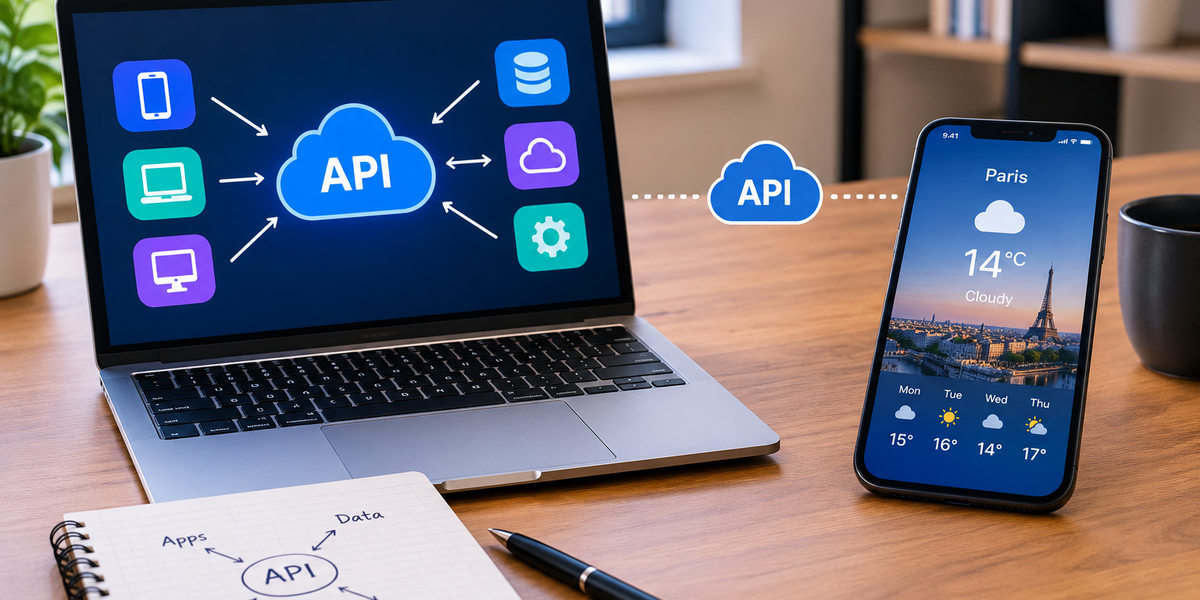
Imagine you’re building a travel app.
You want users to see the current weather in Paris, but you don’t want to build thousands of weather stations around the world and collect all that data yourself.
Instead, you can use a weather provider’s API.
Your app sends a request that essentially says:
What’s the current weather in Paris?
The weather service receives the request, processes it, and sends back structured data.
Your app then turns that data into something friendly, perhaps:
Paris: 14°C, cloudy.
Your users don’t need to know another company’s system was involved.
They simply see the weather.
That’s the basic job of an API: allowing one system to ask another system for something in a predictable way.
The Restaurant Analogy
One of the easiest ways to understand APIs is to imagine a restaurant.
You sit at a table.
The kitchen contains ingredients, equipment, and chefs who can prepare food. But customers aren’t normally allowed to walk into the kitchen and start opening refrigerators.
Instead, you use a menu.
The menu tells you what you’re allowed to request.
You give your order to a waiter.
The waiter takes the request to the kitchen.
The kitchen prepares the food.
The waiter brings the result back.
In this analogy, you are one application, the kitchen is another system, and the waiter is similar to an API.
The API provides a controlled way to make requests without giving you unrestricted access to everything happening inside the other system.
This separation is extremely useful.
A company can let developers use certain functionality without exposing its entire internal infrastructure.
APIs Are Contracts Between Software Systems
An API isn’t simply a doorway.
It also defines rules.
The API documentation might specify which requests are available, what information must be included, what format the information should use, how users authenticate, what responses look like, and what happens when something goes wrong.
In that sense, an API is a contract.
If you send the request in the expected format, the service promises to return a response in a defined format.
For example, an API might say:
Send a request containing a city name.
We’ll return the temperature, weather conditions, humidity, and forecast.
Software developers can build applications around that predictable behavior.
What Is an API Request?
An API request is simply one system asking another system to do something or provide information.
Suppose a shopping app wants information about product number 12345.
Conceptually, it might ask:
Give me the details for product 12345.
The API receives that request.
If everything is valid, it might respond with information such as:
name: Wireless Headphones
price: 79.99
in_stock: true
The shopping app can then display:
Wireless Headphones — $79.99 — In Stock
The customer never sees the raw API response.
The app translates the structured information into a user interface.
APIs Usually Have Endpoints
APIs commonly expose specific addresses called endpoints.
An endpoint represents a particular resource or action available through the API.
Imagine an online bookstore.
It might have different endpoints for books, customers, orders, and reviews.
One endpoint might retrieve a particular book.
Another might create an order.
Another might return a customer’s previous purchases.
Instead of allowing an application to access the bookstore’s database directly, the API provides controlled routes for performing approved operations.
It’s similar to having different service counters inside a large building.
You go to one counter for payments, another for returns, and another for customer support.
Each one has a specific purpose.
What Are GET, POST, PUT, and DELETE?
Many web APIs use HTTP, the same underlying protocol used by websites.
HTTP defines methods that communicate what kind of action is being requested.
GET usually means you want to retrieve information.
For example:
“Give me this customer’s orders.”
POST commonly means you want to create something or submit data.
“Create a new order.”
PUT is often used to replace or update a resource.
“Update this customer’s information.”
DELETE generally means exactly what it sounds like.
“Delete this saved address.”
The exact behavior depends on how the API is designed, but these conventions make APIs easier for developers to understand.
What Does an API Response Look Like?
Computers need information in predictable formats.
Many modern APIs return information using JSON, which stands for JavaScript Object Notation.
A simplified response might look like this:
{
"city": "Paris",
"temperature": 14,
"condition": "cloudy"
}
To a person, that already looks reasonably understandable.
To software, it’s even more useful because the structure makes it easy to identify specific pieces of information.
The app can extract temperature and display 14°C.
It can extract condition and display a cloud icon.
The API provides the data.
The application decides how to present it.
What Happens When an API Request Fails?
Not every request works.
Maybe you asked for something that doesn’t exist.
Maybe your login credentials are invalid.
Maybe the server is temporarily unavailable.
Maybe you’ve made too many requests.
APIs therefore return status information explaining what happened.
You’ve probably encountered one famous example:
404 Not Found
HTTP APIs use status codes to communicate outcomes.
Codes beginning with 2 generally indicate success.
Codes beginning with 4 usually indicate a problem with the request, such as missing authentication or requesting something that doesn’t exist.
Codes beginning with 5 generally indicate a problem on the server side.
For developers, these codes help applications decide what to do next.
How Do APIs Know Who You Are?
Many APIs aren’t open for anyone to use without restriction.
They require authentication.
One simple method involves an API key.
A company gives a developer a unique key, and the application includes that key when making requests.
The service can then identify who is making the request.
More sophisticated systems use access tokens and authorization frameworks such as OAuth.
You’ve probably encountered OAuth without realizing it.
When a website offers a button such as Continue with Google, you’re seeing an authorization flow that allows systems to work together without simply giving the new website your Google password.
Instead, permissions and tokens are used to control access.
Authentication and Authorization Aren’t the Same Thing
These two concepts are closely related but different.
Authentication asks:
Who are you?
Authorization asks:
What are you allowed to do?
Imagine entering an office building.
Your employee badge proves your identity. That’s authentication.
But your badge might let you enter the second floor while preventing you from entering a restricted server room.
That’s authorization.
APIs often need both.
A system needs to know which user or application is making a request and whether that user or application has permission to perform the requested action.
Why Not Just Give Applications Direct Database Access?
Suppose a bank wants a budgeting app to display your account balance.
The bank could theoretically give the app direct access to its internal database.
That would be a terrible idea.
The budgeting app might see information it shouldn’t. A programming mistake could modify data. A compromised application could become a serious security problem.
An API provides a controlled layer in between.
The bank can expose one approved operation:
Retrieve the balance for this authorized account.
The API can verify permissions, validate the request, record what happened, and return only the information the application is allowed to receive.
The internal database remains protected behind that interface.
APIs Let Companies Reuse Existing Services
Imagine every online shop had to build its own payment network.
Every travel website had to create its own mapping system.
Every app had to build its own email delivery infrastructure.
Software development would be dramatically slower and more expensive.
APIs allow companies to reuse services that already exist.
A developer can connect an application to payment processing, mapping, email delivery, cloud storage, authentication, analytics, translation, AI, shipping, and thousands of other services.
Instead of rebuilding everything from scratch, developers combine specialized systems.
Modern applications are therefore often less like single self-contained programs and more like ecosystems of connected services.
APIs Power Online Payments
Suppose you buy a pair of shoes online.
The store needs to process your payment, but it may not operate the payment infrastructure itself.
When you click Pay, the store’s software can communicate with a payment provider through APIs.
Information is sent securely.
The payment provider processes the transaction.
The provider sends a response.
The store then shows you whether your purchase was successful.
Multiple financial systems may be involved behind the scenes.
To you, the entire experience looks like one website.
That’s one of the things APIs do best: hide complexity.
APIs Power “Sign In With…” Buttons
You’ve probably created an account by selecting:
Continue with Google
or a similar option from another provider.
Instead of creating an entirely separate username and password, the website asks an identity provider to help verify who you are.
APIs and authorization protocols allow the systems to exchange the necessary information securely.
Importantly, the website generally doesn’t receive your password for the other service.
Instead, it receives tokens or approved account information according to the permissions you’ve granted.
Again, two separate companies can create what feels like one seamless experience.
APIs Power Your Phone Apps
Many mobile apps would be almost empty without APIs.
Open a weather app and it may request forecast data.
Open a banking app and it requests your account information.
Open a delivery app and it may communicate with restaurant systems, payment services, mapping platforms, driver-location services, and notification systems.
The app on your phone is often only the visible front end of a much larger network of services.
Every time you tap something, APIs may be firing behind the scenes.
One button can trigger several different systems.
APIs Also Connect a Company’s Own Systems
APIs aren’t only used between different companies.
Large applications are often divided into smaller internal services.
An e-commerce company might have separate services for user accounts, inventory, payments, shipping, recommendations, and notifications.
Those systems need to communicate.
APIs provide standardized ways for them to do that.
When you place an order, one service might verify inventory. Another processes payment. Another creates the shipment. Another sends the confirmation email.
To you, it’s one transaction.
Behind the scenes, several systems may have coordinated through APIs.
What Is a REST API?
You’ll often hear developers talk about REST APIs.
REST is an architectural style commonly used for designing web APIs.
A REST-style API typically organizes information around resources and uses standard HTTP methods such as GET, POST, PUT, PATCH, and DELETE to interact with them.
For example, an API might represent customers, products, and orders as resources.
REST became popular partly because it fits naturally with the technologies already used by the web.
But REST isn’t the only approach.
APIs can use technologies such as GraphQL, SOAP, gRPC, WebSockets, and many other communication patterns.
For a non-developer, the important point is simply that there are different ways to design the conversation between computer systems.
What Are Rate Limits?
Imagine a weather service allows other applications to use its API.
One application suddenly sends ten million requests in a few seconds.
That could overwhelm infrastructure or create enormous costs.
API providers therefore often use rate limits.
A rate limit controls how many requests a user or application can make within a certain period.
For example, a service might allow a certain number of requests per minute.
If an application exceeds that limit, the API may temporarily reject additional requests.
Rate limiting helps protect infrastructure, control costs, and prevent abuse.
APIs Can Cost Money
Some APIs are free.
Others charge based on usage.
A company might offer a small number of requests for free and then charge for additional requests.
Another might charge per thousand API calls.
AI APIs may charge based on the amount of text, images, audio, or computing resources processed.
Mapping services might charge based on map loads or requests.
This means a developer building an application has to think about API costs just as a traditional business thinks about electricity, rent, or shipping.
If an app suddenly becomes extremely popular, its API bill can increase dramatically.
What Is an API Integration?
When someone says two systems are “integrated,” APIs are often involved.
Suppose your company’s online store connects to its accounting software.
Every time an order is placed, the store sends information to the accounting system.
Instead of an employee manually copying every transaction, the systems communicate automatically.
That’s an integration.
APIs make integrations possible because they give each system a defined way to send and receive information.
This is why modern business software often advertises hundreds or thousands of integrations.
The more systems that can communicate, the less information needs to be transferred manually.
APIs Are Now Powering AI Applications
APIs have become even more visible with the growth of artificial intelligence.
A developer doesn’t necessarily need to build and train an AI model from scratch to add AI capabilities to an application.
Instead, the application can send a request to an AI service through an API.
For example, an app might send text and ask:
Summarize this document.
The AI service processes the request and sends the result back.
The app then displays the summary to the user.
The same principle can be used for generating text, analyzing images, transcribing audio, translating languages, writing code, or performing other AI tasks.
The AI model may run on enormous remote infrastructure.
The application simply talks to it through an API.
Why APIs Matter So Much
APIs allow software developers to build on top of other software.
That’s enormously powerful.
Instead of every company building every capability itself, organizations can specialize.
One company builds excellent payment infrastructure.
Another builds mapping technology.
Another handles communication.
Another provides cloud storage.
Another develops AI models.
Developers then combine these capabilities through APIs to create new products.
This modular approach dramatically accelerates software development.
It’s one of the main reasons a small team can build an application today that would once have required an enormous organization.
The Modern Internet Is a Giant Conversation Between APIs
When you use an app, it may feel like you’re interacting with one product.
Often, you’re actually interacting with many systems at once.
The app asks one API for your account information.
Another checks inventory.
Another calculates shipping.
Another processes your payment.
Another generates a map.
Another sends a notification.
Another analyzes user activity.
Another might generate an AI response.
All of these conversations can happen within seconds.
You don’t see them because APIs are designed to operate behind the interface.
The Simple Version
An API is a structured way for one piece of software to communicate with another.
One system sends a request.
The API checks whether that request is valid and allowed.
Another system performs an action or retrieves information.
The API sends a response back.
The application uses that response to do something useful.
That’s it.
The technology underneath can become incredibly sophisticated, but the fundamental idea is simple: APIs let software ask other software for things.
And once software can reliably communicate with other software, developers don’t have to build everything themselves.
They can connect existing services, combine capabilities, automate processes, and create entirely new products on top of them.
That’s why APIs aren’t just a technical detail hiding behind modern apps.
They’re part of the invisible infrastructure holding the modern internet together.